

Legislative Updates
Advocacy
CALL TO ACTION

Support for Funding the National Institute on Disability, Independent Living, and Rehabilitation Research (NIDILRR) for FY 2026
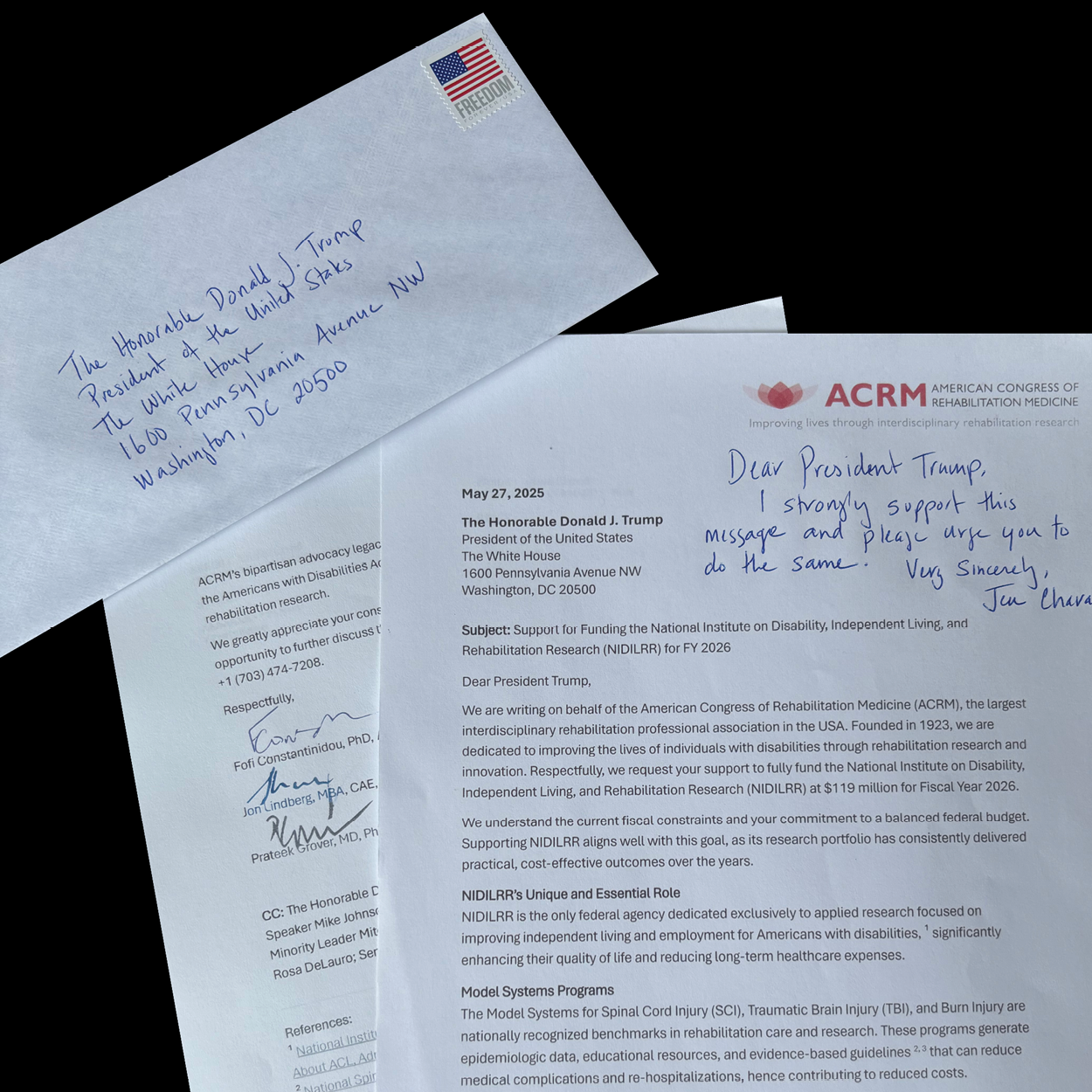
ACRM has written to every U.S. Senator, Representative, and top leaders in government to request $119 million in FY 2026 funding for NIDILRR. The letter highlights NIDILRR’s unique role in disability research that improves lives, supports employment, and reduces healthcare costs through programs like the Model Systems and community initiatives.
Support for Funding the National Institute on Disability, Independent Living, and Rehabilitation Research (NIDILRR) for FY 2026
ACRM has written to every U.S. Senator, Representative, and top leaders in government to request $119 million in FY 2026 funding for NIDILRR. The letter highlights NIDILRR’s unique role in disability research that improves lives, supports employment, and reduces healthcare costs through programs like the Model Systems and community initiatives.

ACRM sends letter to President Donald J. Trump; all U.S. Senators; all members of the House of Representatives; and top government officials to advocate for the preservation of NIDILRR and funding for disability research.
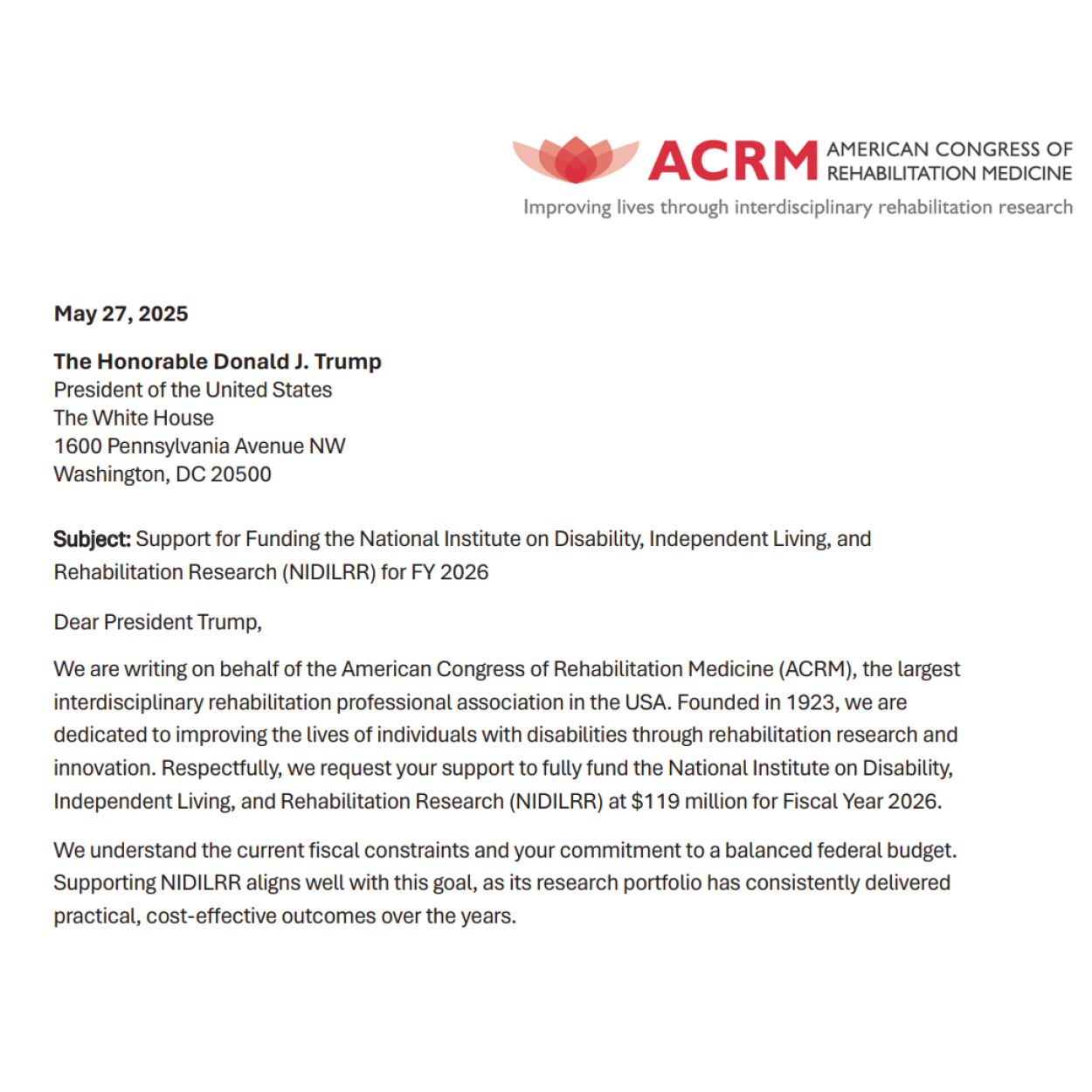
The American Congress of Rehabilitation Medicine (ACRM) has formally written to President Donald J. Trump to express continued support for the National Institute on Disability, Independent Living, and Rehabilitation Research (NIDILRR).
This outreach underscores NIDILRR’s critical role in advancing evidence-based research that enhances the quality of life, independence, and community participation for individuals with disabilities.
ACRM Letter to President Donald J. Trump Advocates for Disability Research
The American Congress of Rehabilitation Medicine (ACRM) has formally written to President Donald J. Trump to express continued support for the National Institute on Disability, Independent Living, and Rehabilitation Research (NIDILRR).
This outreach underscores NIDILRR’s critical role in advancing evidence-based research that enhances the quality of life, independence, and community participation for individuals with disabilities.
Join the Efforts
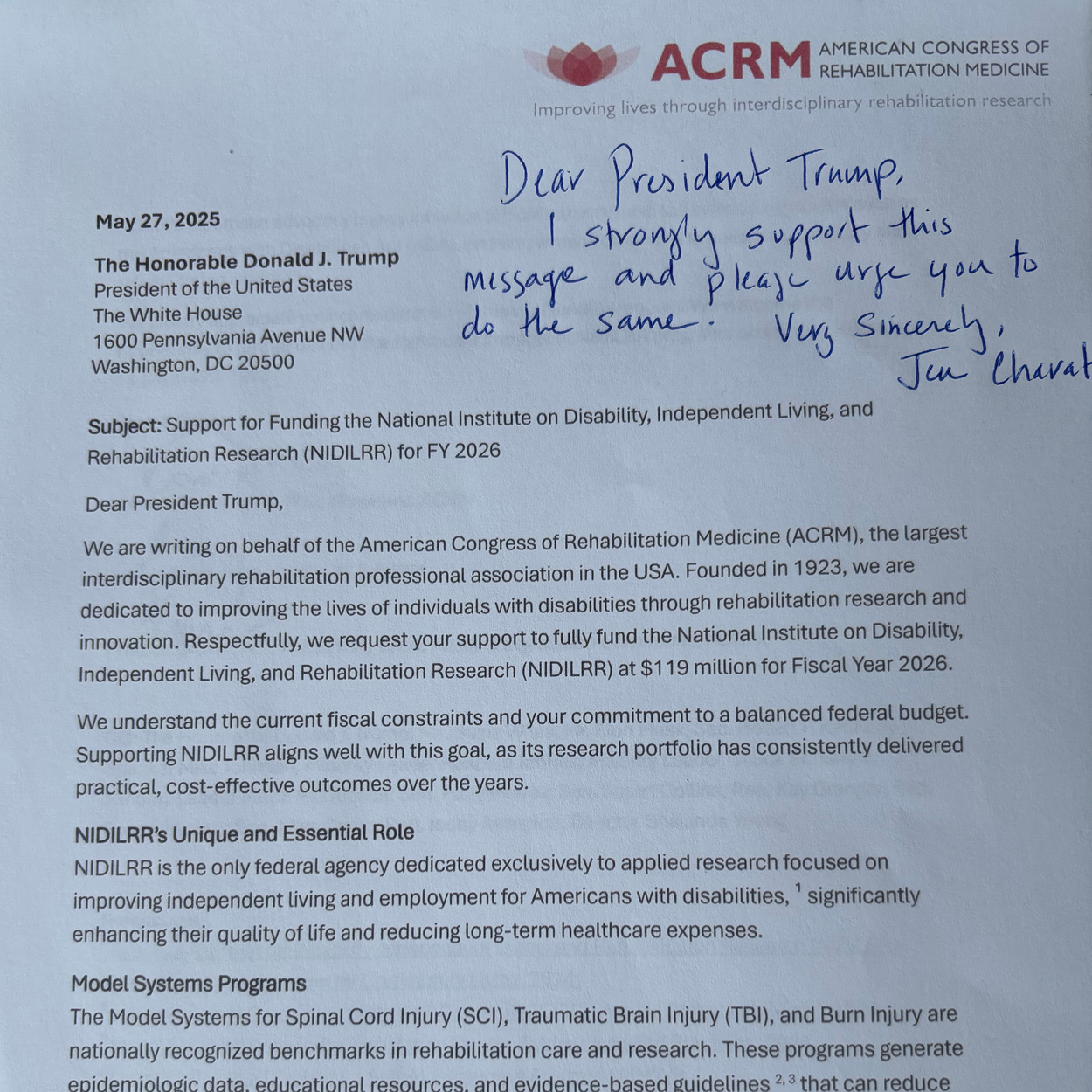
Print or download our letter, handwrite or attach your support, and send it to your member of Congress and Senators.
Step 1
View the letter we’ve sent to your members of Congress and Senators. This letter outlines our shared concerns and recommendations.
Step 2
Download and print this letter to add your personal note of support by hand or attach a separate digital message to include with it.
Step 3
Once you’ve added your message, send the completed letter along with your note to your member of Congress and Senators.
ACRM — through its Policy & Legislation Committee — continues to serve two essential functions:
-
- Supporting coalition-led advocacy
- Reporting major federal policy developments that impact rehabilitation services, research, and access, in collaboration with the Disability and Rehabilitation Research Coalition (DRRC), Coalition to Preserve Rehabilitation (CPR), and the Independence Through Enhancement of Medicare and Medicaid (ITEM) Coalition.
ACRM — through its Policy & Legislation Committee — continues to serve two essential functions:
-
- Supporting coalition-led advocacy
- Reporting major federal policy developments that impact rehabilitation services, research, and access, in collaboration with the Disability and Rehabilitation Research Coalition (DRRC), Coalition to Preserve Rehabilitation (CPR), and the Independence Through Enhancement of Medicare and Medicaid (ITEM) Coalition.
Summary of ACRM Actions Related to Health and Human Services (HHS) Fiscal Year 2026 Budget and Policy Changes from ACRM President Fofi Constantinidou, PhD, CCC-S. CBIS, FACRM, FASHA, Jon Lindberg, ACRM CEO, and Prateek Grover, ACRM Policy & Legislation Committee Chair.
Get Involved
To make your voice heard, enter your zip code and find your representative, enter your state to find your senator.
To view the initiative’s ACRM has partnered with the DRRC, CPR and ITEM Coalition please click on 2025 to expand the summary list
ACRM tracks and organizes these updates through three key national coalitions — CPR, DRRC, and ITEM — each playing a vital role in advancing access, protecting disability rights, and strengthening rehabilitation services across the country. Use the sections below to explore the latest initiatives, priorities, and policy actions from each coalition.
January 26, 2026
ITEM Coalition letters of support for two separate veterans-related bills that ITEM supported in the previous Congress. Both bills have officially been reintroduced in the 119th Congress and we would like to demonstrate our continued support to Capitol Hill for both pieces of legislation
The first bill is H.R. 6835, the Veterans Spinal Trauma Access to New Devices (“STAND”) Act of 2025. This bipartisan legislation, which the ITEM Coalition endorsed in the 118th Congress, would direct the Secretary of Veterans Affairs to offer annual preventative health evaluations under the Department of Veterans Affairs (“VA”) benefit to veterans with spinal cord injuries and disorders and increase access to state-of-the-art assistive mobility technologies, such as Exoskeletal systems and other neuromodulation technologies, which allow paralyzed veterans the ability to improve their function and even walk again.
Full details here >>
The second bill is S. 3138, the Veterans Supporting Prosthetics Opportunities and Recreational Therapy (“SPORT”) Act. This bill, which the ITEM Coalition also endorsed in the 118th Congress, would provide coverage under the VA benefit for prosthetic limbs that veterans with limb loss use to participate in physical activities in order to remain fit, healthy, and as functional as possible. Specifically, this bill would recognize coverage of activity-specific prosthetic limbs as medically necessary under the VA benefit which the ITEM Coalition fully supports. As its title suggests, access to activity-specific prostheses would entail access to the recreational therapy veterans may need to learn how to safely perform these physical activities.
Full details here >>
January 1, 2026
HCPCS coding reform: Toolkit Resource to Education Members o Hydrophilic Urinary Catheter Billing Codes (which goes live January 1, 2026)
Key message is: clinicians should update prescriptions now to ensure continued access to the hydrophilic catheters they prescribe and avoid disruptions when new billing codes take effect on January 1, 2026.
Beginning on January 1, 2026, the Centers for Medicare and Medicaid Services (CMS) will introduce new HCPCS billing codes specific to hydrophilic catheters. For many years, hydrophilic and non-hydrophilic catheters shared the same codes. This update better reflects hydrophilic technology, but it also means that prescriptions must be written differently going forward.
What clinicians need to know:
- New prescriptions: Write “hydrophilic” or include the brand name/item number. Do not include HCPCS codes.
- Renewal prescriptions: Expect updated scripts from suppliers. Review carefully, confirm “hydrophilic” or brand name/item number is included, and remove HCPCS codes.
- Updating prescriptions this way ensures they are valid in 2025 and with the new billing codes starting on January 1, 2026.
To make it easy for you to communicate this change, we created a brand-agnostic toolkit with ready-to-use materials you can share with your members:
- Newsletter/letter copy
- Blog article
- Short blog/newsletter version
- Two email templates (initial announcement + reminder)
- Four social media posts
We encourage you to share these resources, and act now. Early updates protect clinicians’ prescribing decisions, prevent delays, and ensure patients stay on the catheter they were prescribed.
Full deatils here >>
ACRM tracks and organizes these updates through three key national coalitions — CPR, DRRC, and ITEM — each playing a vital role in advancing access, protecting disability rights, and strengthening rehabilitation services across the country. Use the sections below to explore the latest initiatives, priorities, and policy actions from each coalition.
December 19, 2025
CPR - 2026 Labor-HHS-Education Appropriations package
Final CPR letter of support to Senate leadership urging for swift passage of the Senate’s FY 2026 Labor-HHS-Education Appropriations package was successfully submitted to Senate leadership offices December 19, 2025
Full details here >>
December 16, 2025
CPR SIGN-ON OPPORTUNITY: Letter of Support for the Senate Labor-HHS-Education Appropriations Bill
CPR letter of support to Senate leadership urging them to bring to the floor and pass the bipartisan federal fiscal year (“FY”) 2026 Labor, Health and Human Services, Education, and Related Agencies (Labor-HHS) Appropriations package. As many of you may be aware, the Senate’s FY 2026 Labor-HHS Appropriations bill provides stable—and in several cases strengthened—funding for programs that support rehabilitation and disability research, workforce development, patient protection, and community living.
In contrast, the House FY 2026 proposal would make significant cuts to core disability, rehabilitation, public health, and aging programs at a time when demand for these services continues to grow. The letter notes that the Senate Labor-HHS bill offers a bipartisan, responsible path forward that protects vulnerable populations and maintains national commitments to rehabilitation access, scientific advancement, and disability rights, and it encourages Senate leadership to expeditiously pass the Senate’s version of the bill and include it in the anticipated upcoming federal funding package.
Full details here >>
December 5, 2025
ITEM Coalition Members
Centers for Medicare and Medicaid Services (“CMS”) issued the CY 2026 Home Health and Durable Medical Equipment, Prosthetics, Orthotics, and Supplies (“DMEPOS”) Competitive Bidding Program final last Friday, November 28th. The ITEM Coalition is deeply disappointment that CMS seemingly ignored the concerns shared by the disability community and decided to move forward and finalize provisions in the rule that exposes Medicare patients to the lowest bidder for ostomy and urological supplies, as well as certain orthotic braces, under the Medicare program. To make matters worse, CMS accelerated the timeline and some of the changes go into effect as early as next year.
The ITEM Coalition is examining all available options to address our concerns, and will continue our efforts to help ensure access and preserve the diversity of products, suppliers, and clinically appropriate options required to meet the specific medical needs of all Medicare beneficiaries, particularly beneficiaries with disabilities. In the meantime, we implore CMS to immediately pause implementation of this flawed policy and work collaboratively with the disability, patient, and clinical communities to ensure beneficiary access remains the highest priority.
Please find attached an ITEM Coalition press release here >>
December 1, 2025
CPR Letter of Support
CPR letter of concern to the Department of Veterans’ Affairs (“VA”) regarding its decisions to: (1) discontinue the use of CARF International (“CARF”) accreditation for Veterans Health Administration (“VHA”) rehabilitation programs; and (2) terminate the uSPEQ veteran experience survey within CARF-accredited VHA rehabilitation programs.
The letter specifically urges the VA to immediately reinstate both CARF accreditation and the uSPEQ survey system. Restoring these accreditation services would reaffirm the VA’s longstanding commitment to transparency, accountability, and continuous improvement in the care of our nation’s heroes. CPR firmly believes that veterans deserve a rehabilitation system grounded in independent evaluation, evidence-based standards, and, above all, respect for the veteran’s voice.
Full details here >>
December 1, 2025
Centers for Medicare and Medicaid Services (“CMS”) published the CY 2026 Home Health and Durable Medical Equipment, Prosthetics, Orthotics, and Supplies (“DMEPOS”) Competitive Bidding Program Final Rule in the Federal Register
A link to the text is available here: https://public-inspection.federalregister.gov/2025-21767.pdf
For the corresponding CMS Fact Sheet, click here: https://www.cms.gov/newsroom/fact-sheets/calendar-year-cy-2026-home-health-prospective-payment-system-final-rule-cms-1828-f
To access the DMEPOS CBP Fact Sheet, click here: https://www.cms.gov/newsroom/fact-sheets/durable-medical-equipment-prosthetics-orthotics-supplies-competitive-bidding-program-updates
November 26, 2025
Coalition to Preserve Rehabilitation Request to Reinstate CARF Accreditation and uSPEQ Surveys for Veterans Health Administration’s Rehabilitation Programs FINAL Letter
CPR letter of concern to the Department of Veterans’ Affairs (“VA”) regarding its decisions to: (1) discontinue the use of CARF International (“CARF”) accreditation for Veterans Health Administration (“VHA”) rehabilitation programs; and (2) terminate the uSPEQ veteran experience survey within CARF-accredited VHA rehabilitation programs was submitted to the VA this morning.
Full details here >>
November 26, 2025
DRCC
At 1:00 PM today, DRRC sent our letter to Senate leadership and the Appropriations Committee in support of the Senate L-HHS bill. This letter reinforces the message DRRC has consistently conveyed to Congress throughout the year advocating for full funding of critical disability and rehabilitation research programs.
Full details here >>
November 25, 2025
Support for Senate Passage of the FY 2026 Appropriations Bill for Labor, Health and Human Services, Education, and Related Agencies
The Senate is currently reviewing several full-year funding bills to pass as a “minibus,” including its version of the Labor-HHS appropriations bill for fiscal year (FY) 2026. After consulting with the Steering Committee, DRRC has decided to endorse the Senate bill as it aligns with our mission to maximize federal funding for disability and rehabilitation research programs. A detailed comparison of the Senate bill against the House proposal and the President's Budget can be found here. Additionally, we are concerned about disruptions to the federal research agenda and grant funding processes in FY 2026. The six-week government shutdown has already caused significant setbacks, and we face the possibility of additional delays if another shutdown occurs after the current Continuing Resolution expires on January 30, 2026. A full year of appropriations for HHS would allow federal research entities to plan out the rest of the year.
Attached is a letter to Senate leadership and the Appropriations Committee endorsing the Senate L-HHS bill. This letter reinforces the message DRRC has consistently conveyed to Congress throughout the year advocating for full funding of critical disability and rehabilitation research programs.
Full details here >>
November 19, 2025
Continuing Resolution Signed Into Law and the Federal Government Reopened
CPR Members:
As you have likely seen, yesterday the House of Representatives passed (222-209)—and the President signed into law last night—a continuing resolution (“CR”) to fund the federal government and resume normal operations through January 30, 2026. With this action, federal departments and programs that were affected by the record-breaking 43-day shutdown will begin the process of reopening and restoring activities over the coming days.
The CR includes three full-year funding bills (through September 30, 2026, rather than January) collectively called a “minibus.” One bill funds the Department of Agriculture, including full funding for the Supplemental Nutrition Assistance Program (“SNAP”), while another funds military construction and the Department of Veterans Affairs. Another facet of the “minibus” allows for salaries and allowances to go toward the legislative branch.
More importantly, the end of the government shutdown allows furloughed federal workers to return to work and back pay to go to both furloughed workers and those who continued working through the shutdown. The deal also reverses the Trump Administration’s layoffs during the shutdown and prohibits federal funds from being “used to initiate, carry out, implement, or otherwise notice a reduction in force to reduce the number of employees within any department, agency, or office of the Federal Government” until January 30, 2026. This layoff freeze temporarily protects the federal workers who were terminated at the U.S. Department of Education, thereby allowing disabled students and their families continued support and federal civil rights protections, such as those under the Individuals with Disabilities Education Act (“IDEA”).
Additional provisions were included in the CR that are of interest to CPR, including:
- Sec. 6208. Extension of certain telehealth flexibilities. This section extends Medicare telehealth flexibilities that were extended in the Consolidated Appropriations Act, 2023, through January 30, 2026, but retroactive to October 1st.
- Sec. 6213. Medicare Sequestration. This section extends by one month the mandatory 2% Medicare sequestration payment reductions as a pay-for.
- Sec. 8001. Budgetary Effects. This section prevents/waives the 4% Statutory PAYGO sequestration cuts to Medicare, agriculture, and other programs, which would have gone into effect January 1, 2026.
Additional guidance from CMS is forthcoming with respect to the provisions included in the CR, including the telehealth flexibility extension. However, all of the telehealth flexibilities that were available prior to October 1st are reinstated through the end of January 2026 and retroactive to October 1, 2025.
We will continue to monitor any impacts or delays as agencies return to full operations and will keep you informed of any relevant updates impacting CPR’s advocacy priorities.
A link to a section-by-section summary of the CR is available here >>
November 18, 2025
DRRC-Informational DoEd. Break Up and Senate L-HHS Bill Moving
1. The U.S. Department of Education today announced six new interagency agreements to break up the Department. | Read Press Release here: U.S. Department of Education Announces Six New Agency Partnerships to Break Up Federal Bureaucracy | U.S. Department of Education. We will update you with more details as they become available. The press release includes some details on programs that are moving to Department of Labor, Department of Health and Human Services, Department of State, and Department of Interior.
2. The Senate is developing a “mini-bus” appropriations package that includes funding for several departments, notably the Department of Health and Human Services. GOP leadership is considering which bills to combine with Department of Defense funding, including appropriations for Labor, HHS, Transportation, HUD, Interior, Commerce, and Justice. The Senate L-HHS bill in consideration includes $116.9 billion for the Health and Human Services Department, a 1.6% increase from fiscal 2025 levels. The bill would not enact deep cuts to education and health programs requested by the White House. The Senate bill is strongly preferred to the House’s bill which includes cuts to programs like NIDILRR and CDC. More funding levels are detailed in the DRRC memo from September comparing the House, Senate, and President’s Budget Request: DRRC Memo on FY 2026 Appropriations: House, Senate, President's Budget Request (D1196621).DOCX and spreadsheet.
November 13, 2025
House of Representatives passed (222-209)—and the President signed into law last night—a continuing resolution (“CR”) to fund the federal government and resume normal operations through January 30, 2026
As you have likely seen, yesterday the House of Representatives passed (222-209)—and the President signed into law last night—a continuing resolution (“CR”) to fund the federal government and resume normal operations through January 30, 2026. With this action, federal departments and programs that were affected by the record-breaking 43-day shutdown will begin the process of reopening and restoring activities over the coming days.
The CR includes three full-year funding bills (through September 30, 2026, rather than January) collectively called a “minibus.” One bill funds the Department of Agriculture, including full funding for the Supplemental Nutrition Assistance Program (“SNAP”), while another funds military construction and the Department of Veterans Affairs. Another facet of the “minibus” allows for salaries and allowances to go toward the legislative branch.
More importantly, the end of the government shutdown allows furloughed federal workers to return to work and back pay to go to both furloughed workers and those who continued working through the shutdown. The deal also reverses the Trump Administration’s layoffs during the shutdown and prohibits federal funds from being “used to initiate, carry out, implement, or otherwise notice a reduction in force to reduce the number of employees within any department, agency, or office of the Federal Government” until January 30, 2026. This layoff freeze temporarily protects the federal workers who were terminated at the U.S. Department of Education, thereby allowing disabled students and their families continued support and federal civil rights protections, such as those under the Individuals with Disabilities Education Act (“IDEA”).
Additional provisions were included in the CR that are of potential interest to ITEM Members, including:
• Sec. 6208. Extension of certain telehealth flexibilities. This section extends Medicare telehealth flexibilities that were extended in the Consolidated Appropriations Act, 2023, through January 30, 2026, but retroactive to October 1st.
• Sec. 6213. Medicare Sequestration. This section extends by one month the mandatory 2% Medicare sequestration payment reductions as a pay-for.
• Sec. 8001. Budgetary Effects. This section prevents/waives the 4% Statutory PAYGO sequestration cuts to Medicare, agriculture, and other programs, which would have gone into effect January 1, 2026.
Additional guidance from CMS is forthcoming with respect to the provisions included in the CR, including the telehealth flexibility extension. However, all of the telehealth flexibilities that were available prior to October 1st are reinstated through the end of January 2026 and retroactive to October 1, 2025.
We will continue to monitor any impacts or delays as agencies return to full operations and will keep you informed of any relevant updates impacting the ITEM Coalition’s advocacy priorities.
A link to the final LCD is available here: LCD - Urological Supplies (L33803)
A link to the related Policy Article is available here: Article - Urological Supplies - Policy Article (A52521)
For CMS’s response to the comments received, please click here: Article - Response to Comments: Urological Supplies - DL33803 (A60353)
November 6, 2025
DME MAC Medical Directors Publish Final Urological Supplies Local Coverage Determination (LCD) (Update)
We are pleased to report that the long-awaited Local Coverage Determination (“LCD”) for Urological Supplies has been published, and the ITEM Coalition is very pleased with the results. The ITEM Coalition submitted comments in support of the proposed LCD on October 10th, and we are thrilled to see that the Durable Medical Equipment Medicare Administrative Contractors (“DME MAC”) Medical Directors finalized the addition of the new hydrophilic urinary catheter codes and, as proposed, added spinal cord injury (“SCI”) at any level to qualify for access to sterile catheter kits, which help reduce dangerous urinary tract infections.
More importantly, we are pleased that the DME MACs have also clarified in the policy article that “For intermittent catheterization using a sterile intermittent catheter kit (A4297, A4353), documentation in the medical record of a diagnosis of SCI is sufficient to establish that the beneficiary is immunocompromised” (emphasis added), which is one of the key criteria for Medicare coverage of sterile catheter kits. The effective date for these changes is January 1, 2026.
The ITEM Coalition applauds the DME MACs for finalizing these important changes to the Urological Supplies LCD, and we greatly appreciate the DME MACs for expanding coverage of sterile catheter kits to include immunosuppressed beneficiaries with SCI at any level. These finalized changes represent a critically important step toward aligning policy with both clinical evidence and patient need. The clinical literature clearly demonstrates the high correlation between sustaining an SCI and resulting immunosuppression. We believe this should be the standard for coverage, i.e., that every beneficiary with SCI should be considered immunosuppressed and eligible for sterile catheter kits.
In our comments, the ITEM Coalition urged the DME MACs to go even further in the final LCD or subsequent LCDs to expand coverage of sterile catheter kits to individuals living with neurogenic bladder disorder due to congenital and non-congenital conditions. However, CMS did not address neurogenic bladder in the final LCD because it was “outside the scope” of the proposed LCD. This will continue to be a goal of the ITEM Coalition for future consideration.
Regardless, this final LCD represents a significant victory for the disability community as this coverage expansion promotes equitable access to essential urological care, reduces preventable complications, and ensures that patients receive treatment consistent with current clinical standards of practice.
A link to the final LCD is available here: LCD - Urological Supplies (L33803)
A link to the related Policy Article is available here: Article - Urological Supplies - Policy Article (A52521)
For CMS’s response to the comments received, please click here: Article - Response to Comments: Urological Supplies - DL33803 (A60353)
November 6, 2025
Trump Administration announced a landmark decision to expand coverage of anti-obesity medications (“AOMs”)
Description Today, the Trump Administration announced a landmark decision to expand coverage of anti-obesity medications (“AOMs”) for the treatment of obesity under the Medicare and Medicaid programs. This decision marks a tremendous victory not only for the disability community at large, but for the ITEM Coalition membership as well, which has prioritized support for this coverage expansion since it was originally proposed in November 2024 by the Biden Administration.
By expanding coverage of anti-obesity medications under the Medicare and Medicaid programs, the Administration is advancing the principles of independence and function that are central to the ITEM Coalition’s mission. As the ITEM Coalition has consistently emphasized, coverage of anti-obesity medications is not simply about managing weight—it is about restoring function and enabling individuals, especially in the disability community, to live full and independent lives.
While final details of the policy’s implementation are forthcoming, this coverage expansion is a major step forward and we are thrilled with this significant and positive development.
Please find attached a formal ITEM Coalition press release announcing this major coverage policy change for your records.
Full details here >>
November 5, 2025
ACRM signed onto the CPR letter of support for S. 2898, the Dennis John Benigno Traumatic Brain Injury (“TBI”) Program Reauthorization Act of 2025
CPR letter of support for S. 2898, the Dennis John Benigno Traumatic Brain Injury (“TBI”) Program Reauthorization Act of 2025. Introduced on October 8th, this important, bipartisan legislation represents a timely and critical opportunity to reauthorize and strengthen the federal programs that support individuals and families affected by TBI. This letter will be sent to the original Senate sponsors of the bill thanking them for their leadership in sponsoring this important legislation, which will ensure access to the continuum of rehabilitative care and community-based services that brain injury survivors and their families need to recover, improve function, and achieve as much independence and the highest quality of life possible
Full details here >>
October 30, 2025
Item Coalition letter to House and Senate Committees of jurisdiction
ITEM Coalition letter to the leadership of the House and Senate Committees of jurisdiction urging Congress to continue working with the Centers for Medicare and Medicaid Services (CMS) to enable Medicare beneficiaries living with disabilities and chronic obesity to access AOMs through the Medicare Part D program
Full details here >>
October 30, 2025
ITEM Coalition Letter to Committee Leadership re Medicare Coverage of AOMs (Final Draft) 4916-4783-5251
ACRM Signed on to ITEM Coalition letter to the leadership of the House and Senate Committees of jurisdiction urging Congress to continue working with the Centers for Medicare and Medicaid Services (CMS) to enable Medicare beneficiaries living with disabilities and chronic obesity to access AOMs through the Medicare Part D program.
Full details here >>
October 24, 2025
DRRC Letter to Appropriations 4898-3465-9955 v.2
ACRM Signed onto a draft letter to the Chairs and Ranking Members of House and Senate Appropriations Subcommittees on Labor, Health and Human Services, Education and Related Agencies (L-HHS).
Full details here >>
October 15, 2025
ITEM Coalition letters of support for H.R.4475/S. 2329, the Medicare Orthotics and Prosthetics (“O&P) Patient-Centered Care Act.
Please find attached two, identical ITEM Coalition letters of support for H.R.4475/S. 2329, the Medicare Orthotics and Prosthetics (“O&P) Patient-Centered Care Act. One letter will go to the original House sponsors and the other letter will go to the original Senate sponsors thanking them for their leadership in reintroducing this important bill in the 119th Congress. Because this is the same bill from the 118th Congress, which the ITEM Coalition fully supported and endorsed, we have decided to make this an opt-out sign-on opportunity for ITEM Coalition member’s consideration.
ITEM Coalition Draft Letter >>
ITEM Coalition Final Letter >>
October 10, 2025
Topic Process for furnishing durable medical equipment (DME), specifically therapeutic shoes for individuals with diabetes.
Under the Social Security Act, Medicare covers diabetic shoes when prescribed and furnished by a podiatrist (or other qualified physician), provided the managing MD or DO certifies the patient’s eligibility and medical need. However, overly burdensome compliance requirements imposed by the DME MACs have significantly reduced beneficiary access to this critical benefit, leaving patients at increased risk for diabetic foot complications, including ulceration, infection, and amputation. These outcomes not only raise the cost of care but also increase patient morbidity and mortality
Full details here >>
October 9, 2025
ITEM comment letter in support of the recently proposed Local Coverage Determination (“LCD”) on urological supplies (DL33803)
ACRM Signed on to an ITEM Coalition comment letter in support of a recently proposed Local Coverage Determination (“LCD”) on urological supplies (DL33803). Under the proposal, CMS would expand Medicare coverage of sterile intermittent catheter kits for individuals with a spinal cord injury (“SCI”) regardless of the level of injury. The letter expresses the ITEM Coalition’s strong support for this proposed coverage expansion and urges the Durable Medical Equipment Medicare Administrative Contractors (“DME MACs”) to go even further in the final LCD or in future LCDs to consider evidence demonstrating that coverage should be expanded to all individuals with neurogenic bladder regardless of etiology, including congenital conditions.
Full details here >>
October 1, 2025
Item Coalition
As ITEM Coalition Members:
The ITEM Coalition has prepared a grassroots messaging campaign for you to distribute to your respective memberships urging them to contact their Members of Congress to encourage them to sign-on to the Dunn/Murphy letter to the Trump Administration.
Your members can access and send this email in under two minutes using the following link:https://powerslaw.quorum.us/campaign/143586/
September 16, 2025
DRRC FY 2026 Appropriations Summary Memo
DRRC Congressional Appropriations = Summary of Disability and Rehabilitation Programs in Senate and House
L-HHS Appropriations Bill for Fiscal Year (FY) 2026 and President’s
Budget Request for FY 2026 DRRCFY 2026 Appropriations >>
Full details here >
September 16, 2025
ACRM Signed on to the final letter submitted to Congressional leadership voicing opposition to the CMS/OMB proposal to include ostomy, tracheostomy, and urological supplies in the Medicare Competitive Bidding Program
September 12, 2025
CPR Response letter on the CY 2026 Medicare PFS Proposed Rule Submitted on Friday 12 September
CPR comment letter (draft) in response to the CY 2026 Medicare Physician Fee Schedule Proposed Rule. CPR focuses its comments on three specific provisions in the rule. First, we offer comments on the proposed CY 2026 Physician Fee Schedule payment update and conversion factor. The second area we focus on in our comments relates to preserving access to rehabilitation through accurate service valuation. Lastly, we focus on the treatment of telehealth and telerehabilitation going forward as the federal government continues to consider how to maintain access to these services on a permanent basis. Full details here >>
September 8, 2025
DRRC House Releases L-HHS Report
Today, the House Appropriations Committee released the report for fiscal year (FY) 2026 for Labor, Health and Human Services, Education, and Related Agencies (L-HHS). The committee report is a detailed description of the budget and the programs funded. The House bill, report, and summary are linked below. The full committee markup of the L-HHS bill is scheduled for tomorrow, Tuesday, September 9 at 11 (ET).
• House L-HHS Report for FY 2026: https://docs.house.gov/meetings/AP/AP00/20250909/118593/HMKP-119-AP00-20250909-SD002.pdf
• House L-HHS Bill for FY 2026: https://appropriations.house.gov/sites/evo-subsites/republicans-appropriations.house.gov/files/evo-media-document/fy26-labor-health-and-human-services-education-and-related-agencies-subcommittee-mark.pdf
Upon initial review, NIDILRR would be funded at $100 million (decrease of $19 million from FY 2025). The House would appropriate $47.8 billion for NIH (decrease of $456 million from FY 2025). Agency for Healthcare Research and Quality (AHRQ) would not be funded. CDC would be funded at $7.4 billion (decrease of $1.7 billion from FY 2025).
August 29, 2025
ACRM Signed on to the ITEM Coalition comment letter on the proposed expansion of the DMEPOS CBP to include ostomy and urological supplies.
August 29, 2025
ITEM Coalition comment letter to CMS opposing the agency’s proposal to include ostomy and urological supplies in the next round of competitive bidding.
August 29, 2025
CPR letter of concern to CMS regarding the Wasteful and Inappropriate Service Reduction (“WISeR”) Model, scheduled to begin on January 1, 2026.
The WISeR Model introduces to the Medicare fee-for-service program a technology-driven, artificial intelligence-fueled, model to review the medical necessity of certain services. It relies on a financially-incentivized prior authorization and pre-payment review framework—much like the Recovery Audit Contractor (“RAC”) program—for select items and services furnished under traditional Medicare in six states (NJ, OH, OK, TX, AZ and WA).
The program takes the form of a five-year demonstration project but the impact of the program is much more pervasive and, potentially, permanent.
The attached letter stresses to CMS that while CPR fully supports efforts to reduce waste, fraud, and abuse in the Medicare program, we are deeply troubled by the potential unintended consequences of the WISeR Model and curbing access to medically necessary medical rehabilitation and therapy services for beneficiaries with disabilities and other chronic conditions.
Read full details here >>
Please Respond by August 29
The National Center for Medical Rehabilitation Research (NCMRR) published a request for information
The National Center for Medical Rehabilitation Research (NCMRR) published a request for information (RFI) on its proposed NIH Research Plan on Rehabilitation Scientific Themes for Fiscal Year (FY) 2026-2030. More details available here >>
1. All comments must be submitted electronically to Rehabilitation1@mail.nih.gov
2. Responses (no longer than 300 words in Microsoft Word or PDF format) must be received by 11:59:59 (ET) on August 29, 2025
3. Please indicate "RFI Response" in the subject line of the email. You will receive an electronic confirmation acknowledging receipt of your response.
We encourage all DRRC member organizations to submit responses.
August 11, 2025
ITEM Coalition educational webinar entitled, Competitive Bidding and Patient Harm: Why Ostomy and Urological Supplies Must Be Exempt.
Please join us on Monday, August 11th, from 2:00-3:00pm ET for an ITEM Coalition educational webinar entitled, Competitive Bidding and Patient Harm: Why Ostomy and Urological Supplies Must Be Exempt.
During this free one-hour webinar, you will learn more about the arguments for why CMS should not move forward with a proposal that was included in the CY 2026 Home Health proposed rule to include ostomy and urological supplies in the next round of Medicare competitive bidding—a move that is contrary to Congressional intent and threatens to undermine patient choice, access and quality for individuals with bowel and bladder management issues who require daily use of ostomy and urological supplies. This includes individuals with paralysis, spina bifida, stroke, and a wide range of other disabling conditions.
Panelists for the webinar include:
Peter W. Thomas, J.D., ITEM Coalition Co-Coordinator
Michael Barnett, J.D., ITEM Coalition Co-Coordinator
Julie Allen, J.D, Principal, Powers Law Firm
Leela Baggett, J.D., Principal, Powers Law Firm
TBD: Other speakers with expertise on ostomy and urological care
Full details available here >>
August 6, 2025
NCMRR hosted a virtual conference, “Rehabilitation Research 2025: Rehabilitation for All.”
The recording will be posted on the NIH website in the coming days: NIH VideoCasting - Past Events
Agenda - Rehabilitation Research 2025: Rehabilitation For All. Congratulations to Dr. Forber-Pratt for her excellent presentation on promoting disability perspectives in rehabilitation research! NIH website here >>
July 23, 2025
DRRC Statement on HHS Cuts
DRRC issued a statement, developed with the steering committee, on the reductions in force (RIFs) at the Department of Health & Human Services (HHS), impacting thousands of employees, after a Supreme Court decision allowing the RIFs proposed earlier this year by the Trump Administration to proceed. See statement here >>
ACL and NIDILLR-supporting staff were seriously impacted with whole offices left completely without staff. We fear that, without an alternative plan of action by ACL/HHS, these empty positions are likely to slow or even stop the flow of grant dollars for certain programs. Here’s an article providing more details on HHS wide layoffs: HHS finalizes 'portion' of layoffs after Supreme Court ruling. More details available here >>
July 21, 2025
NAAOP Press Release for Bipartisan Re-introduction of Medicare O&P Patient-Centered Care Act (H.R. 4475; S. 2329) in U.S. House and Senate
announcing the reintroduction of H.R. 4475/S. 2329, the Medicare Orthotics and Prosthetics (“O&P”) Patient-Centered Care Act. This transformative legislation has been endorsed by the ITEM Coalition in previous Congresses, and we are pleased to again be supportive in the 119th Congress. This bipartisan and bicameral bill reflects a strong, united commitment to improving access to high-quality orthotic and prosthetic care for individuals with limb loss and limb impairment while protecting the Medicare program from waste, fraud, and abuse. Full details available here >>
July 21, 2025
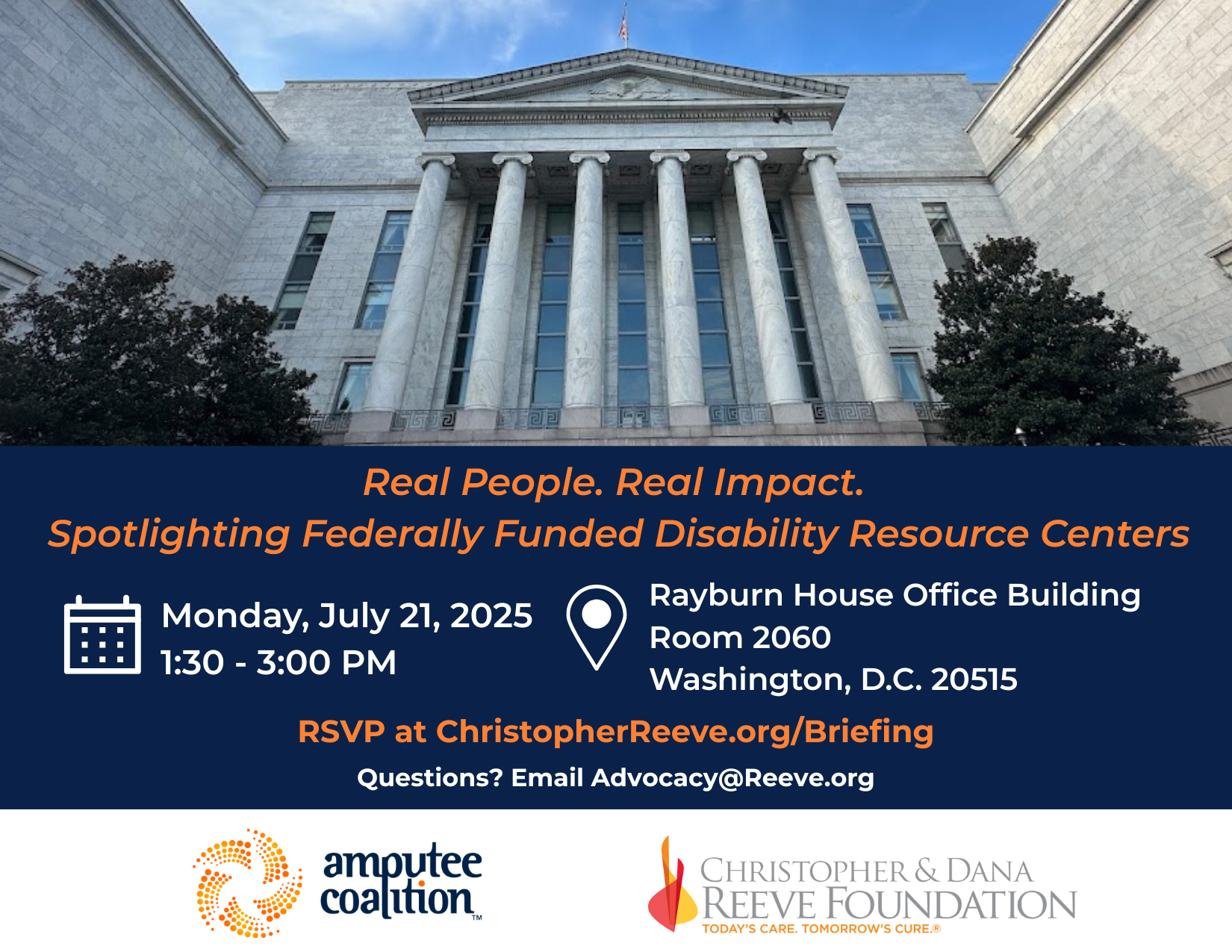
ITEM Coalition and CPR are supporting: The Christopher & Dana Reeve Foundation is hosting a Congressional briefing to spotlight the critical importance of federally funded disability resource centers.
The briefing will be held in-person on Monday, July 21st at 1:30pm ET at the Rayburn House Office Building (Room 2060). We wanted to pass this information along to ensure ITEM members were aware and to encourage those who are able to attend and show support. (ACRM is not aware of a option to attend virtually) Full details available here >>
July 17, 2025
ACRM signed onto the ITEM Coalition endorsed via sign-on letter in the 118th Congress, the Medicare Orthotics & Prosthetics (“O&P”) Patient-Centered Care Act.
The bill was a bipartisan and bicameral bill in the 118th Congress that would ensure Medicare beneficiaries can access the orthotics and prosthetics devices they need. Under current Medicare requirements, beneficiaries are at risk of receiving orthotic and prosthetic devices without the necessary services and customization required for the best use. The bill will clarify the law and permit Medicare beneficiaries who require prosthetics and orthotics to receive these important services.
The bill is expected to be reintroduced next week on Wednesday, July 17, 2025, by Reps. Glenn “GT” Thompson (R-PA), Mike Thompson (D-CA), Gus Bilirakis (R-FL), and Debbie Dingell (D-MI). GT Thompson’s office is preparing a press release and has asked if the organizations on record in support of the bill during the 118th Congress continue to support the bill. Full details available here >>
July 15, 2025
ITEM Coalition Support for a More Robust Pathway for Medicare Coverage of Breakthrough Technologies - ACRM Signed onto the letter
ACRM signed-on in support of an ITEM Coalition letter to the Centers for Medicare and Medicaid Services (“CMS”) encouraging the agency to initiate future rulemaking to create and establish a timelier and more predictable pathway for Medicare coverage of Food and Drug Administration (“FDA”)-designated breakthrough medical technologies. Specifically, the letter urges CMS to move forward with a much more robust and streamlined coverage pathway—similar to the Medicare Coverage of Innovative Technology (“MCIT”) framework—providing time-limited Medicare coverage for FDA-designated breakthrough technologies upon a determination that they are safe and effective.
This type of policy, which the ITEM Coalition has endorsed previously, is aligned with the legislative language included in S. 1717, the Ensuring Patient Access to Critical Breakthrough Products Act of 2025, that is currently being considered in the 119th Congress. Such a policy would remove unnecessary regulatory barriers and accelerate patient access to critical innovations—supporting clinicians in delivering the best possible care and helping improve health outcomes for millions of individuals with disabilities, functional limitations, and chronic conditions Full details available here >>
July 14, 2025
ITEM Coalition ACRM Signed onto a letter focusing on power standing systems in response to the Department of Health and Human Services’ (“HHS”) Request for Information (“RFI”) entitled, “Ensuring Lawful Regulation and Unleashing Innovation to Make American Healthy Again.”
The letter specifically urges CMS to direct the Durable Medical Equipment Medicare Administrative Contractors (“DME MACs”) to remove language in Local Coverage Article (“LCA”) A52504 indicating that Medicare does not cover power standing features to remove barriers for claim-by-claim consideration of Medicare coverage of power standing systems for Medicare beneficiaries for whom these systems are medically necessary. The letter also urges the agency again to move forward with opening the long-pending National Coverage Analysis (“NCA”) for power standing systems as soon as possible. Full details available here >>
July 11, 2025
ITEM Coalition ACRM signed on to a letter in Support of Continued Funding for National Limb Loss and Paralysis Resource Centers
These centers, which are administered by the Administration for Community Living (“ACL”), fulfill critical needs for a large swath of ITEM Coalition constituencies by providing free, comprehensive information, peer support, and navigational assistance that empower Americans living with limb loss, limb difference, or paralysis to live independently and fully participate in their communities. The letter urges Congressional leadership to not move forward with the proposal to eliminate funding for these critical programs and to appropriate continued, sustained, and robust funding for both centers Full details available here >>
July 10, 2025
ITEM Coalition ACRM signed on to a letter in Support of Continued Funding for National Limb Loss and Paralysis Resource Centers
These centers, which are administered by the Administration for Community Living (“ACL”), fulfill critical needs for a large swath of ITEM Coalition constituencies by providing free, comprehensive information, peer support, and navigational assistance that empower Americans living with limb loss, limb difference, or paralysis to live independently and fully participate in their communities. The letter urges Congressional leadership to not move forward with the proposal to eliminate funding for these critical programs and to appropriate continued, sustained, and robust funding for both centers Full details available here >>
July 7, 2025
CPR letter of support for S. 1816/H.R. 3514, the Improving Seniors Timely Access to Care Act
This bipartisan and bicameral bill, which CPR has strongly supported in the previous two Congresses, was recently reintroduced in the 119th Congress and it would reform the use of prior authorization in the Medicare Advantage (“MA”) program. More specifically, the bill would help protect patients, including those in need of rehabilitation care, from unnecessary delays in care due to overuse and misuse of prior authorization in MA. The bill would also streamline and standardize the use of prior authorization in many situations and provide much-needed transparency for rehabilitation patients in the MA program, all of which CPR supports. Full details available here >>
June 26, 2025
ITEM Coalition Meeting Request to Discuss Pending National Coverage Analysis for Standing Systems in Power Wheelchairs
The FINAL letter to The Honorable Mehmet OZ, MD Administrator Centers for Medicare and Medicaid Services (“CMS”) requesting a meeting to discuss the status of the long-pending National Coverage Analysis (“NCA”) for standing systems in Group 3 power wheelchairs has been submitted. Full details available here >>
June 25, 2025
ACRM signed onto a letter with the ITEM Coalition for a meeting request with the Honorable Mehmet Oz, MD Administrator for CMS to discuss pending national coverage analysis for standing systems in power wheelchairs
ITEM Coalition SIGN On to Letter regarding a Meeting Request with the Honorable Mehmet Oz, MD Administrator for CMS to Discuss Pending National Coverage Analysis for Standing Systems in Power Wheelchairs Full details available here >>
June 25, 2025
ACRM Signed on to the Final letter from CPR and HAB (Habilitation Benefits Coalition) CPR/HAB Coalition letter to Senate leadership in response to the Senate Finance Committee’s draft reconciliation package was submitted to Capitol Hill yesterday afternoon
CPR and HAB (Habilitation Benefits Coalition) CPR/HAB Coalition letter to Senate leadership in response to the Senate Finance Committee’s draft reconciliation package was submitted to Capitol Hill yesterday afternoon. Full details available here >>
June 24, 2025
Letter to Senate Leadership Majority and Minority Leaders Thune and Schumer, and Chair and Ranking Member Crapo and Wyden on Medicaid
Given the nature and magnitude of the impact of the Medicaid proposals on individuals with disabilities and chronic conditions, we feel it is imperative for our coalitions to respond expeditiously. While the letter maintains a respectful tone, it firmly expresses our opposition to these proposals at a broad level and clearly outlines the reasons for our concerns. Full details available here >>
June 13, 2025
Item Coalition - Websites and Software Applications Accessibility Act
FINAL letter of support for H.R. 3417, the Websites and Software Applications Accessibility Act, was officially submitted to Rep. Pete Sessions’ (R-TX) office this afternoon, June 13, 2025 Full details available here >>
June 11, 2025
Item Coalition - Websites and Software Applications Accessibility Act. H.R. 3417
This bill, which was recently reintroduced in the 119th Congress by Rep. Pete Sessions (R-TX), would require that websites and applications used by covered entities (employment entities, public entities, public accommodation, or testing entities) to communicate or interact with applicants, employees, participants, customers, or other members of the public be readily accessible to and useable by individuals with disabilities. The ITEM Coalition supported this bill in the 118th Congress Full details available here >>
June 11, 2025
CPR Comment Letter Response to Medicare Program; Inpatient Rehabilitation Facility Prospective Payment System FY 2025
Medicare Program; Inpatient Rehabilitation Facility Prospective Payment System for Fiscal Year 2026 and Updates to the IRF Quality Reporting Program Proposed Rule (CMS-1829-P) (ACRM Signed on) Full details available here >>
June 10, 2025
CPR Summary Memo
On May 30, 2025, the Department of Health and Human Services (“HHS”) released a briefing document outlining the Trump Administration’s Fiscal Year (“FY”) 2026 budget request. Additional documents have been released in recent days that provide additional justification for the proposals in the FY 2026 budget. These documents provide the clearest picture to date of the Administration’s proposed funding priorities and structural reforms across HHS agencies. Below is a CPR memo summarizing the proposed agency-level changes in the President’s FY 2026 budget, as well as highlights from the June 10th hearing where National Institutes of Health (“NIH”) Director, Dr. Jay Bhattacharya, testified before the Senate Appropriations Labor, Health and Human Services, Education, and Related Agencies (“LHHS”) Subcommittee on the President’s budget request for the NIH. Full details available here >>
June 10, 2025
Letter Submitted: A CPR comment letter in response to the FY 2026 IRF PPS Proposed Rule was officially submitted to the Centers for Medicare and Medicaid Services (“CMS”) June 10, 2025
Our comments focus on key provisions of the proposed rule—including the proposed FY 2026 payment update, administrative burden reduction, proposed changes to the IRF Quality Reporting Program, and responses to various requests for information included in the proposed rule—with the goal of ensuring that Medicare beneficiaries continue to have access to the full range of medically necessary rehabilitation services Full details available here >>
June 10, 2025
Sign on Request FY 2026 IRF PPS Proposed Rule Final Draft
Draft CPR Coalition comment letter to the Centers for Medicare and Medicaid Services (“CMS”) in response to the Fiscal Year (“FY”) 2026 Inpatient Rehabilitation Facility Prospective Payment System (“IRF PPS”) Proposed Rule. Our comments focus on key provisions of the proposed rule—including the proposed FY 2026 payment update, administrative burden reduction, proposed changes to the IRF Quality Reporting Program, and responses to various requests for information included in the proposed rule—with the goal of ensuring that Medicare beneficiaries continue to have access to the full range of medically necessary rehabilitation services. Full details available here >>
June 10, 2025
Senate Appropriations Committee, LHHS Subcommittee - “A Review of the President’s Fiscal Year 2026 Budget Request for the National Institutes of Health”
Today June 10, the Senate Appropriations Committee met to hear from the NIH Director Jay Bhattacharya regarding the fiscal year 2026 President’s Budget Request. This request included a total restructure of NIH into 8 institutes from 27 and a 40% cut in funding. Attached is a summary that Emma Gunter prepared of relevant remarks from senators and the NIH director. Full details available here >>
Webinar Recording Now Available: Educational Webinar on the Intersection Between Disability and Obesity
Educational webinar sponsored by the National Association for the Advancement of Orthotics and Prosthetics (NAAOP) entitled, “The Intersection Between Disability and Obesity.” The webinar explored the complex relationship between disability and obesity, including the clinical, social, and policy considerations around expanded coverage of anti-obesity medications (AOMs) under the Medicare and Medicaid programs. We also discussed opportunities for advocacy, both at the Administrative and Congressional levels, to address barriers to accessing clinically appropriate care for all individuals, but especially those living with disabilities.
Panelists who joined us to provide their respective organization’s perspectives on the issue, including Dr. Prateek Grover, M.D., PhD, MHA, with the American Congress of Rehabilitation Medicine; Nikki Grace, who sits on the NAAOP Board of Directors; Ashlie White, MSHLS, MA, with the Amputee Coalition; and Sara Brown, MPA, Senior Director of Government Affairs at Prevent Blindness. We very much appreciated the collaboration and thoughtful discussion, and we are pleased to share the recording of the webinar for those who were unable to attend or would like to revisit the presentation.
Please click here >>
June 10, 2025
Medicare Program; Inpatient Rehabilitation Facility Prospective Payment System for Fiscal Year 2026 and Updates to the IRF Quality Reporting Program Proposed Rule (CMS-1829-P)
CPR Coalition comment letter to the Centers for Medicare and Medicaid Services (“CMS”) in response to the Fiscal Year (“FY”) 2026 Inpatient Rehabilitation Facility Prospective Payment System (“IRF PPS”) Proposed Rule. Our comments focus on key provisions of the proposed rule—including the proposed FY 2026 payment update, administrative burden reduction, proposed changes to the IRF Quality Reporting Program, and responses to various requests for information included in the proposed rule—with the goal of ensuring that Medicare beneficiaries continue to have access to the full range of medically necessary rehabilitation services View request letter here here >>
Full details available here >>
June 5, 2025
DRRC-NIH/NCMRR Sign on Letter Deadline June 9
The Disability and Rehabilitation Research Coalition (DRRC) requests that you to review the letter in this link (https://forms.gle/tvhRESXyEeCvYRk6A) to determine whether you are willing to sign on to support full funding for medical rehabilitation and disability-related research at the National Institutes of Health (NIH), particularly, the National Center for Medical Rehabilitation Research (NCMRR) within the Eunice Kennedy Shriver National Institute of Child Health and Human Development (NICHD), in the FY 2026 Labor, Health and Human Services, Education, and Related Agencies Appropriations bill.
In addition, NIH Director, Jay Bhattacharya, MD, Ph.D., will testify before the Senate Appropriations Committee on June 10th at 10:00 AM (ET). We plan to submit this letter for the record of this hearing and distribute it widely among all Senate offices. We urge all DRRC members and NIH supporters to use the Google link above to review and sign on to the letter, as well as submit your own individual organizational testimony. Here is guidance from the committee on submitting outside witness testimony: https://www.appropriations.senate.gov/imo/media/doc/owt_guidelines_lhhs_fy_26.pdf Deadline to sign on is June 9
Full details available here >>
May 29, 2025
Sign on to support full funding for the National Institute on Disability, Independent Living, and Rehabilitation Research (NIDILRR) in Federal Fiscal Year 2026
NIDILRR is under serious threat and a showing of broad support from researchers, universities, research institutions, clinicians, providers, and especially rehabilitation, disability and independent living organizations would significantly help our prospects for funding NIDILRR at sufficient levels in the coming fiscal year. Although there are also threats to restructuring NIDILRR, this letter focuses only on funding levels for FY 2026 Full details available here >>
May 29, 2025
ITEM Coalition & CPR: Educational webinar sponsored by the National Association for the Advancement of Orthotics and Prosthetics (“NAAOP”) entitled, The Intersection Between Disability and Obesity
There is no fee for participation in this webinar, but we do ask that you please register beforehand to ensure you receive the proper webinar link. A registration link is available here >>
Full details available here >>
May 28, 2025
AMRPA Inpatient Rehabilitation Facility (IRF) Prior Authorization Survey Results
We wanted to share important information with the full CPR membership regarding the results of a recent nationwide survey on prior authorization practices in Inpatient Rehabilitation Facilities (“IRFs”) under the Medicare Advantage (“MA”) program. The survey, conducted by the American Medical Rehabilitation Providers Association (“AMRPA”)—a fellow CPR member—examines how MA plan’s prior authorization policies are impacting access to care in freestanding inpatient rehabilitation hospitals and rehabilitation units.
Key Findings: The use of prior authorization by Medicare Advantage plans has long posed challenges for patients and providers in the inpatient rehabilitation setting. To assess the current landscape, AMRPA surveyed IRFs nationwide to better understan
- The frequency with which MA plans deny prior authorization for IRF admissions;
- The timeliness of those determinations; and
- The real-world consequences of such practices on patient care.
The survey, which captured data from July–August 2024, revealed troubling trends:
- The average wait time for an initial decision from an MA plan was slightly over 2.5 days, causing delays in access to IRF care.
- MA plans denied IRF admissions more than 57% of the time—overriding the clinical judgment of rehabilitation physicians.
- This denial rate exceeds the rate reported in AMRPA’s similar survey from August 2021, despite new regulatory reforms that went into effect in January 2024.
- These denials translated into at least 70,000 days of delay in IRF admission decisions during the two-month period alone.
- Extrapolated for the full calendar year and across all IRFs nationwide, this would represent 1.2 million days spent waiting for decisions. Because the vast majority of IRF referrals come from acute care hospitals, these delays create significant downstream costs and strain on the health care system. More importantly, seriously impaired MA beneficiaries—those in critical need of intensive rehabilitation—are directly harmed by both denials and prolonged wait times for necessary care.
Additional Resources:
- Full survey results and a two-page summary are attached for your review.
- You can also access the results on AMRPA’s website: https://amrpa.org/medicare-advantage-prior-authorization-survey/
Read the full survey results >>
May 20, 2025
CPR Alert & Improving Seniors’ Timely Access to Care Act - Strategy Planning Meeting
The Improving Seniors’ Timely Access to Care Act is slated for introduction tomorrow, May 20th, 2025, by U.S. Senators Roger Marshall, M.D. (R-KS) and Mark Warner (D-VA), and U.S. Representatives Mike Kelly (R-PA), Suzan DelBene (D-WA), Ami Bera, M.D. (D-CA), and John Joyce, M.D. (R-PA). We are thrilled that the bill already has 71 endorsing organizations, 23 Senate cosponsors, and 34 House cosponsors. Full details available here >>
May 14, 2025
DRRC - Quill Letter #L26370 - FY26 NIDILRR Model Systems and Dear colleague letters
Letter to Senator Tammy Duckworth in support of NIDILRR funding call to action Full details available here >>
May 10, 2025
CPR SIGN-ON OPPORTUNITY: CPR Welcome Letter and Meeting Request to CMS Administrator Dr. Oz
CPR letter to the new CMS Administrator, Dr. Mehmet Oz, welcoming him to his new role and requesting a meeting to discuss how CMS and CPR can work together going forward to ensure that Medicare and Medicaid beneficiaries Full details available here >>
May 7, 2025
SUBMITTED: ITEM Coalition Letter to Congressional Leadership Urging for Protection of DMEPOS Access Under Medicaid
The ITEM Coalition letter to Congressional leadership highlighting the critical need to protect Medicaid beneficiaries’ access to durable medical equipment, prosthetics, orthotics, and supplies (DMEPOS) was submitted this morning Full details available here >>
May 1, 2025
INFORMATIONAL: NCMRR and NIH
Earlier this week, we met with Rep. Andrew Clyde (R-GA) on the House LHHS Appropriations Subcommittee. We created 3 one (or two) pagers for DRRC conversations that are attached to this email for your use and distribution: About DRRC, NCMRR/NIH, and NIDILRR Full details available here >>
May 1, 2025
INFORMATIONAL: NIDILRR
Summary Earlier this week, we met with Rep. Andrew Clyde (R-GA) on the House LHHS Appropriations Subcommittee. We created 3 one (or two) pagers for DRRC conversations that are attached to this email for your use and distribution: About DRRC, NCMRR/NIH, and NIDILRR Full details available here >>
May 1, 2025
INFORMATIONAL: ABOUT DRRC
Earlier this week, we met with Rep. Andrew Clyde (R-GA) on the House LHHS Appropriations Subcommittee. We created 3 one (or two) pagers for DRRC conversations that are attached to this email for your use and distribution: About DRRC, NCMRR/NIH, and NIDILRR Full details available here >>
April 30, 2025
Letter to CMS Administrator, Dr. Mehmet Oz, regarding the recent decision not to finalize the proposed expanded coverage for anti-obesity medications (“AOMs”)
Disability community letter to CMS Administrator, Dr. Mehmet Oz, regarding the recent unfortunate decision not to finalize the proposed expanded coverage for anti-obesity medications (“AOMs”) that was included in the CY 2026 Medicare Advantage and Medicare Part D Prescription Drug Benefit Programs proposed rule. Full details available here >>
April 29, 2025
ACL- Quill Letter I124424 Letter from the DRRC to HHS on the Elimination of the Administration for Community Living. To Honorable Robert F Kennedy Jr
strong opposition letter to Honorable Robert F Kennedy Jr Of inquiry requesting the President, and directing the Secretary of Health and Human Services, to transmit respectively, to the House of Representatives certain documents relating to the elimination of the Administration for Community Living Full details available here >>
April 28, 2025
ACL-Letter (this is the letter to the Honorable Robert F Kennedy Jr) Letter from the DRRC to HHS on the Elimination of the Administration for Community Living
Strong opposition letter to Honorable Robert F Kennedy Jr Of inquiry requesting the President, and directing the Secretary of Health and Human Services, to transmit respectively, to the House of Representatives certain documents relating to the elimination of the Administration for Community Living Full details available here >>
April 28, 2025
DRRC Update
House Democrats submitted a resolution requesting President Trump and Secretary Kennedy to answer questions relating to the elimination of the ACL Full details available here >>
April 24, 2025
Bills-119hes344ih Filing of a letter to 119th Congress 1st Session H. RES. 344
Bills-119hes344ih.pdf (Filing of a letter to 119th Congress 1st Session H. RES. 344 Of inquiry requesting the President, and directing the Secretary of Health and Human Services, to transmit respectively, to the House of Representatives certain documents relating to the elimination of the Administration for Community Living. Full details available here >>
April 21, 2025
CPR & ITEM Coalition Sign On Letter Disability Community Response to Anit-Obesity Medication Coverage Expansion Decision Letter to Dr. Mehmet Oz
CPR & ITEM Coalition Sign On to a disability community letter to CMS Administrator, Dr. Mehmet Oz, regarding the recent unfortunate decision not to finalize the proposed expanded coverage for anti-obesity medications (“AOMs”) that was included in the CY 2026 Medicare Advantage and Medicare Part D Prescription Drug Benefit Programs proposed rule Full details available here >>
April 16, 2025
AMA Update on Therapy Caps
We wanted to pass along a short 15-minute podcast that the American Medical Association (AMA) published this morning on the impact of therapy caps on rehabilitation therapy services. The podcast is very well done and features CPR steering committee member, Sam Porritt with the Falling Forward Foundation, as well as Dr. Atul Patel who is a member of the American Academy of Physical Medicine & Rehabilitation, which is also a CPR member. A link to the podcast is available here >>
April 16, 2025
CPR Memo re: CY 2026 Medicare Advantage and Medicare Part D Final Rule
FY 2026 IRF PPS Proposed Rule – Key Updates for Members : CMS proposes a 2.8% payment increase for Inpatient Rehabilitation Facilities (IRFs) in FY 2026, totaling $295 million, based on a 3.4% market basket update minus a 0.8% productivity cut. The rule removes 2 COVID-19 vaccine measures and 4 Social Determinants of Health (SDOH) items from the IRF Quality Reporting Program (QRP). The outlier threshold drops from $12,043 to $11,971. Data submission deadlines would shorten to 45 days. CMS seeks feedback on digital measurement, interoperability, nutrition, and delirium. Public comments are due by June 7, 2025. Full details available here >>
April 15, 2025
Summary of FY 2026 IRF Prospective Payment System Proposed Rule
Friday, April 11th, the Centers for Medicare and Medicaid Services (“CMS”) released the federal Fiscal Year (“FY”) 2026 Inpatient Rehabilitation Facility Prospective Payment System (“IRF PPS”) Proposed Rule (CMS-1829-P) for public inspection. The proposed rule is relatively straightforward and short this year (only 95 pages total). Overall, the proposed rule would provide a modest 2.8% payment increase for IRFs in FY 2026. For the QRP, CMS proposed to remove two measures related to COVID-19 vaccination requirements beginning with the FY 2026 (CY 2024) and FY 2028 (CY 2026) IRF QRP, respectively. CMS is also proposing to remove four social determinants of health (“SDOH”) patient assessment data elements to reduce burden beginning October 1, 2025. The agency is also proposing to amend its reconsideration policy and process on which IRFs can appeal IRF QRP payment penalties and also includes four separate RFIs on the IRF QRP in general. Full details available here >>
April 11, 2025
ITEM Coalition Support for the Mobility Means Freedom Tax Credit Act; H.R. 2320
ACRM endorses the ITEM Coalition’s proposed Mobility Means Freedom Tax Credit Act of 2025 (H.R. 2320), which offers a 50% tax credit to individuals purchasing qualified mobility devices for themselves, a spouse, or a dependent. The credit offsets high out-of-pocket costs for essential equipment like wheelchairs, prosthetics, and orthotics—helping individuals live more independently. Though especially beneficial for Medicare beneficiaries, it applies broadly. Aligned with the ITEM Coalition’s expanded mission to promote access to assistive technology, ACRM views this legislation as a constructive step toward improving mobility, autonomy, and quality of life. Full details available here >>
April 9, 2025
Item Coalition Press Release on Anti-Obesity Medication Coverage Expansion Decision
the Centers for Medicare and Medicaid Services (“CMS”) issued the CY 2026 MA and Medicare Part D final rule this past Friday afternoon and decided not to move forward with finalizing the proposed coverage expansion for anti-obesity medications (“AOMs”) at this time. The ITEM Coalition submitted extensive comments in support of this proposed coverage decision back in January, so we wanted to ensure ITEM members were aware of this development. While we are ultimately disappointed with the Trump Administration’s decision, we remain encouraged by the prospects for inclusion in future rulemaking and will continue to urge the agency to revisit this issue through the lens of the disability community and to address the intersect between disability and obesity in any future rulemaking as soon as possible. Full details available here >>
April 9, 2025
ITEM Coalition & CPR: Trump Administration Publishes the CY 2026 Medicare Advantage and Medicare Part D Final Rule
CMS’s CY 2026 Rate Announcement finalizes Medicare Advantage (MA) and Part D payment policies, projecting a 5.06% average increase in MA payments—over $25 billion. Key updates include a 100% transition to the 2024 CMS-HCC risk adjustment model and a -3.01% impact from model revisions and Fee-for-Service normalization. The Part D redesign incorporates Inflation Reduction Act provisions: a $2,100 out-of-pocket cap, insulin cost limits, and zero-cost adult vaccines. CMS also added transparency to Star Ratings, adjusted Puerto Rico rates, and began transitioning PACE risk scoring to encounter data for greater accuracy and reduced burden. Full details available here >>
March 31, 2025
ITEM Coalition Support Letter DMEPOS Relief Act of 2025 Letter of Support (Apr 1) (Durable Medical Equipment, Prosthetic Devices, Prosthetics, Orthotics, & Supplies (DMEPOS)
Please find attached an ITEM Coalition letter of support for H.R. 2005, the DMEPOS Relief Act of 2025, which was recently reintroduced by Rep. Mariannette Miller-Meeks (R-IA), for your review and sign-on consideration. H.R. 2005 would provide critically-needed funding relief to many home medical equipment (“HME”) providers across the country and ensure continued access to these essential medical supplies for seniors and individuals with disabilities. More specifically, the bill would re-establish the 75/25 blended Medicare reimbursement rate for DMEPOS in non-rural/non-Competitive Bidding Areas through the end of 2025. This 75/25 blended rate expired on January 1, 2024, and was a much-needed lifeline for DMEPOS suppliers and providers and afforded beneficiaries continued access to the level of care and services that they needed. Full details available here >>
March 27, 2025
CBS News Article on Physical Therapy Caps
We wanted to pass along an article that was published this morning by CBS News on physical therapy cap limits and the impact that the caps have had on patients in need of rehabilitation care. Two CPR members (the Falling Forward Foundation and the Academy of Physical Medicine & Rehabilitation) are mentioned in the article, and we are pleased that it has finally been published. With national coverage like this, even more people across the country will have a better understanding of this important issue and we wanted to share it with the CPR membership to ensure you were aware.
"It's the gross reality in America right now," said Sam Porritt, chairman of the Falling Forward Foundation, a Kansas-based philanthropy that has paid for therapy for about 200 patients who exhausted their insurance over the past decade. "No one knows about this except people in the industry. You find out about it when tragedy hits."
A link to the story is available here: Their physical therapy coverage ran out before they could walk again - CBS News
March 27, 2025
DRRC – HHS REORG ANNOUNCED
HHS has announced sweeping restructuring, including the launch of the Administration for a Healthy America (AHA), which merges agencies like SAMHSA, HRSA, and others to focus on primary care, mental health, and environmental health. Notably, the Administration for Community Living (ACL) will be dissolved, with its programs reassigned to the Centers for Medicare & Medicaid Services (CMS), the Assistant Secretary for Planning and Evaluation (ASPE), and the Administration for Children and Families (ACF). ACRM, as part of DRRC, is closely monitoring developments and will continue to keep our community informed. Full details available here >>
March 25, 2025
Litigation update on Airline Accessibility Final Rule
Last week, Paralyzed Veterans of America (“PVA”) filed a motion with the U.S. Court of Appeals for the Fifth Circuit for leave to intervene in Airlines for America et al. v. U.S. Department of Transportation, a legal challenge brought by major U.S. airlines against a landmark Department of Transportation (“DOT”) rule that enhances safety and dignity for air travelers with disabilities. A "motion for leave to intervene" is a formal request by a third party (in this case, PVA) to join an ongoing lawsuit or legal proceeding, arguing that they have a significant interest in the outcome and should be allowed to participate. The regulation at the center of the case is the Ensuring Safe Accommodations for Air Travelers with Disabilities Using Wheelchairs final rule, which was issued in December 2024 following years of advocacy from disability rights organizations, including the ITEM Coalition. The rule sets vital boarding assistance standards, mandates airline personnel training, and provides compensation and rebooking protections for passengers whose wheelchairs or scooters are damaged or mishandled during air travel. The motion was filed by PVA due to broad concern from disability advocates that the airline industry threatens hard-won protections for a population that faces disproportionate risks during air travel. Full details available here >>
March 20, 2025
Item Coalition and CPR Disability Community Support Letter for Proposed AOM Coverage Expansion
Disability community letter in support of the proposed coverage expansion of anti-obesity medications (“AOMs”) for the treatment of obesity under the Medicare and Medicaid programs that was included in the CY 2026 Medicare Advantage and Medicare Part D proposed rule last year. Full details available here >>
March 12, 2025
FINAL LETTER NIH DPCPSI proposed Strategic Plan for Disability Health Research for FY 2026-FY 2030
As a member of Disability & Rehabilitation Research Coalition (DRRC), ACRM supports NIH's efforts to enhance disability research, emphasizing the importance of implementing the Strategic Plan for Disability Health Research FY26-FY30. The DRRC advocates for evidence-based care to improve health, function, quality of life, and independence for Americans with disabilities. The coalition urges the NIH to prioritize biomedical, functional, and outcomes research for the 70 million adults and 4 million children with disabilities. Please reach out to the ACRM Policy and Legislation Committee with your thoughts and suggestions.
Request for Information (RFI): Inviting Feedback on the Framework for the NIH Strategic Plan for Disability Health Research FY26-FY30. Full details available here >>
March 12, 2025
DRRC Sign On Letter NIH Indirect Cost Limit Letters
The letter addressed to OMB, HHS, and NIH raising concerns about the indirect cost policy (more details below in previous emails). It’s focused on the importance of disability and rehabilitation research in general and the impact reductions of funding as a result of the indirect cost cap could have on the future of research.Full details available here >>
March 12, 2025
NIH DPCPSI proposed Strategic Plan for Disability Health Research for FY 2026-FY 2030
As a member of Disability & Rehabilitation Research Coalition (DRRC), ACRM supports NIH’s efforts to enhance disability research, emphasizing the importance of implementing the Strategic Plan for Disability Health Research FY26-FY30. The DRRC advocates for evidence-based care to improve health, function, quality of life, and independence for Americans with disabilities. The coalition urges the NIH to prioritize biomedical, functional, and outcomes research for the 70 million adults and 4 million children with disabilities. Please reach out to the ACRM Policy and Legislation Committee with your thoughts and suggestions. Full details available here >>
March 12, 2025
NIH DPCPSI proposed Strategic Plan for Disability Health Research for FY 2026-FY 2030
As a member of Disability & Rehabilitation Research Coalition (DRRC), ACRM supports NIH's efforts to enhance disability research, emphasizing the importance of implementing the Strategic Plan for Disability Health Research FY26-FY30. The DRRC advocates for evidence-based care to improve health, function, quality of life, and independence for Americans with disabilities. The coalition urges the NIH to prioritize biomedical, functional, and outcomes research for the 70 million adults and 4 million children with disabilities. Please reach out to the ACRM Policy and Legislation Committee with your thoughts and suggestions. Full details available here >>
March, 2025
Item Coalition Support Letter for the DMEPOS Relief Act of 2025
An ITEM Coalition letter of support for H.R. 2005, the DMEPOS Relief Act of 2025, which was recently reintroduced by Rep. Mariannette Miller-Meeks (R-IA), for your review and sign-on consideration. H.R. 2005 would provide critically-needed funding relief to many home medical equipment (“HME”) providers across the country and ensure continued access to these essential medical supplies for seniors and individuals with disabilities. More specifically, the bill would re-establish the 75/25 blended Medicare reimbursement rate for DMEPOS in non-rural/non-Competitive Bidding Areas through the end of 2025. This 75/25 blended rate expired on January 1, 2024, and was a much-needed lifeline for DMEPOS suppliers and providers and afforded beneficiaries continued access to the level of care and services that they needed. Full details available here >>
February 2025
ACRM supports key CPR (Coalition to Preserve Rehabilitation) 2025 policy priorities
ACRM supports key CPR( Coalition to Preserve Rehabilitation) 2025 policy priorities to reform Medicare post-acute care, ensure access to medical rehabilitation, and expand telehealth services. The advocacy efforts extend to preserving Essential Health Benefits, upholding Affordable Care Act protections, increasing awareness and access for Long COVID patients to post-COVID-19 rehabilitation, and responding to regulations that impact rehabilitation services. High-level strategies include engaging with Congress, promoting patient education, and ensuring transparency in healthcare processes. Please reach out to the ACRM Policy and Legislation Committee with your thoughts and suggestions. Full details available here >>
February 2025
ACRM supports key ITEM (Independence Through Enhancement of Medicare and Medicaid) Coalition 2025 policy priorities
ACRM supports key ITEM (Independence Through Enhancement of Medicare and Medicaid) Coalition 2025 policy priorities, including improving Medicare coverage for wheelchairs, low vision aids, new technologies, and expanding rehabilitation services. They advocate for timely service and repairs, access to titanium and carbon fiber wheelchairs, and maintaining Essential Health Benefits. Efforts also address DMEPOS coverage, orthotics and prosthetics policies, and accessible medical diagnostic equipment. They engage with Congress to push for policy advancements and transparency. Please reach out to the ACRM Policy and Legislation Committee with your thoughts and suggestions. Full details available here >>
February 20, 2025
ITEM Coalition Support for Mary Ann Clark’s MEDCAC Nomination Letter
February 18, 2025
ITEM Coalition Policy Priorities for 2025
We are pleased to inform you that the ITEM Coalition’s letter in support of Mary Ann Clark’s nomination to serve on the Medicare Evidence Development & Coverage Analysis Committee (“MEDCAC”) as an industry representative has been submitted Full details available here >>
January 28, 2025
OMB Memo to Executive Departments and Agencies Regarding Pausing Federal Financial Assistance (M-25-13)
Due to the serious consequences of the Trump Administration’s freeze of Federal financial assistance for many programs and activities of significance to the disability community, DRRC Co-Coordinators plans to send the attached letter expressing our concerns, briefly, to the Office of Management and Budget at COB today.Full details available here >>
March 29, 2024
Mobility is Freedom-Scholar Award Program RFA
Deadline for Application:
Applications must be received no later than 11:59 pm, Eastern Time on Friday, March 29, 2024.
Decision date: June 1, 2024.
The Mobility is Freedom Fund (MiFF)-Scholar Award Program supports via an unrestricted research grant of $50,000 distributed over three years, the research and training of talented young doctoral students in rehabilitation science at graduate institutions with the intention of supporting scholars with an interest in advancing knowledge, research and publications related to integrated, multi-disciplinary care for amputees, i.e., persons with limb loss.
The Mobility is Freedom-Scholar Awards Program is open to full-time students who have completed their comprehensive qualifying exam and are engaged in a doctoral dissertation research project at an academic institution in the States, Districts, and Territories of the United States of America that grant a Ph.D. in health sciences or equivalent. Individuals interested in applying should focus on the following key factors: Demonstrated leadership, original scholarly research of outstanding quality, and dedication to training which exhibits evidence of outstanding educational efforts, scholarly research achievements, awards and honors, and publications of research in leading journals.
Charges associated with indirect costs or institutional overhead are not allowed. Institutions may make only one nomination annually for the Mobility is Freedom-Scholar Awards Program. Full details available here >>
(a) via email to AGRM@mindspring.com; and (b) hard copy to: Mobility is Freedom Fund, Post Office Box 42409, Towson, Maryland 21284-2409.
2023
No updates.
2022
No updates.
2021
News from the DRRC
JUNE 2021—The Disability and Research Rehabilitation Coalition (DRRC) has shared two upcoming events that may be of interest to ACRM members. Health Equity Webinar The National Institute for Health Care Management (NIHCM) Foundation is holding a webinar on Achieving Health Equity for People with Disabilities During the Pandemic and Beyond on Monday, 28 June from 1:00 – 2:00 PM ET. The event is free and open to the public. REGISTER HERE TO ATTEND. ICDR Stakeholder Meeting This virtual meeting will share the current accomplishments and vision of the Interagency Committee on Disability Research (ICDR), as well as the future of its mission and activities. It will also provide an overview of the current state of research progress and identify future research priorities in four main topic areas:
- Assistive Technology & Universal Design
- Community Integration & Participation
- Employment & Education
- Health, Functioning & Wellness
DRRC FY 2022 Appropriations Requests to Senate and House
MAY 2021—The Disability & Rehabilitation Research Coalition (DRRC) submitted their FY 2022 appropriations request letters last week to the Senate and House Committees on Labor, Health and Human Services, Education, and Related Agencies. The DRRC recommended that Congress increase funding for NIDILLR by $10 million for a total of $122,970,000 in FY 2022 to respond to the COVID-19 pandemic and support existing needs. A dedicated budget line of $2 million was requested for the Interagency Committee on Disability Research (ICDR). Finally, the DRRC strongly supported the request to appropriate $5 million to fund the National Concussion Surveillance System to improve data collection capturing the extent of concussions in the United States. Read More >>Dr. Anjali J. Forber-Pratt appointed NIDILRR Director
 MAY 2021—After several years of Acting leadership, NIDILRR welcomes their newly appointed permanent director, Dr. Anjali J. Forber-Pratt. A two-time Paralympian and medalist in the sport of wheelchair racing, Dr. Forber-Pratt has dedicated her life to helping others recognize their potential. She began her research career in 2006 at Vanderbilt University where she served as principal investigator for research projects covering a range of disability issues, including training of special education teachers and experiences of students with disabilities at every education level. Today her primary area of expertise is disability identity development.
Dr. Forber-Pratt is pictured here with her service dog, Kolton. Read More >>
MAY 2021—After several years of Acting leadership, NIDILRR welcomes their newly appointed permanent director, Dr. Anjali J. Forber-Pratt. A two-time Paralympian and medalist in the sport of wheelchair racing, Dr. Forber-Pratt has dedicated her life to helping others recognize their potential. She began her research career in 2006 at Vanderbilt University where she served as principal investigator for research projects covering a range of disability issues, including training of special education teachers and experiences of students with disabilities at every education level. Today her primary area of expertise is disability identity development.
Dr. Forber-Pratt is pictured here with her service dog, Kolton. Read More >>
ITEM Coalition Comments on MCIT Interim Final Rule
APRIL 2021—The Independence Through Enhancement of Medicare and Medicaid (ITEM) Coalition submitted comments last week on CMS’ Interim Final Rule on the Medicare Coverage of Innovative Technology (MCIT) pathway. The Coalition supports implementation of the MCIT pathway to expand access to new devices and technology for Medicare beneficiaries. The Coalition also specifically recommended that CMS develop an expedited Benefit Category Determination (BCD), coding, and payment determination process for MCIT-eligible devices, in order to ensure that beneficiaries are afforded timely access to these devices once approved by the Food and Drug Administration. Read More >>CMS authorizes 24 new audiology and SLP codes for provision via telehealth
APRIL 2021—CMS announced that 24 audiology and speech language pathology codes will be newly authorized for provision via telehealth through the end of the COVID-19 PHE. These reflect nearly all of the codes the Coalition to Preserve Rehabilitation requested be added to the telehealth list. Follow the link below to the full list of codes now authorized for telehealth. Read More >>Summary of key provisions of the American Rescue Plan Act
March 2021—On 11 March, President Joe Biden signed the American Rescue Plan Act of 2021, a $1.9 trillion COVID-19 relief and economic stimulus package that passed in the Senate by a simple majority vote under the budget reconciliation process. This package includes a wide range of additional funding for previously enacted COVID-19 public health and fiscal programs, including funds to improve testing, tracing, and vaccinations; expanded benefits for unemployed workers; direct payments to individuals making less than $75,000 annually; and aid to state and local governments. Follow the link below to review a memo summarizing key sections. Read More >>Regulatory SUNSET Rule Delayed
March 2021—The Department of Health & Human Services (HHS) announced that they are delaying the regulatory SUNSET rule, which was finalized in the last days of the Trump Administration. As of now, the department is not rescinding the rule entirely, but may make further changes during the delay period. The rule would have required nearly all regulations from HHS to be substantively reviewed every 10 years and regulations would expire if not affirmatively approved by the department. Some key points are listed below and you can read the complete notice in the Federal Register.- The rule’s effective date is being delayed for one year (until 22 March 2022), allowing time for HHS to review and for a legal challenge to proceed (County of Santa Clara v. HHS).
- HHS now believes it is “likely” some regulations would expire without any additional administrative review due to the volume of regulations needing to be assessed, contrary to the Department’s assertion in the original final rule.
- HHS notes that the rule raises additional administrative law questions about whether regulations can be terminated without individual consideration and stakeholder comment.
- HHS also notes that the potential automatic expiration of rules and programs would create uncertainty and unpredictability in the health care industry.
Medicare Coverage of Innovative Technology (MCIT) rule delayed
March 2021—Last week, CMS formally announced the delay (until 15 May) of the effective date for the final Medicare Coverage of Innovative Technology (MCIT) rule, released in the last days of the Trump Administration. CMS has also opened a new 30-day public comment period until 17 April to address new issues relating to the rule, including:- Operational issues regarding benefit category determinations and payment methodologies
- Potential overlap with provisions of the proposed DMEPOS rule
- New information regarding the amount of eligible devices (higher than expected)
- Need for more detail around the “reasonable and necessary” definition
DRRC recommends comprehensive research agenda to combat COVID-19 disparities
February 2021—The DRRC recently summarized its recommendations in a letter to Dr. Nunez-Smith and the COVID-19 Health Equity Task Force for improving the lives of Americans with disabilities by enhancing the federal commitment to disability, independent living, and rehabilitation research. In particular, this letter addressed:- Critical COVID-19 Research on Disability, Independent Living, and Rehabilitation
- Collection of Demographic Data on COVID-19 Including Disability Status Data
- Support for COVID-Specific Disability and Rehabilitation Research at the Federal Level
Priorities for the Biden Administration
February 2021—On behalf of DRRC, Bobby Silverstein participated in a conference call this month between the disability and aging communities and ACL leadership. Alison Barkoff, Acting Administrator and Assistant Secretary for Aging, Administration for Community Living, described priorities for the Biden Administration, which included, among other things, the need for and importance of disability-related information and data to track and ensure meaningful and effective access to disability, independent living, and rehabilitation services and supports and equity. After the formal presentation and during the Q and A period, Bobby urged the Administration to:- expeditiously appoint a new permanent director of NIDILRR
- actively involve ICDR in collaborative effects to address the COVID pandemic
- recognize the critical importance of COVID-19 research on disability, independent living, and rehabilitation
- institutionalize the urgent need to collect demographic information and data on COVID-19, including disability status data
- support for COVID-specific disability and rehabilitation research at the Federal Level
Final FY 2021 Omnibus Summary
February 2021—The DRRC recently provided ACRM members a summary memo regarding the FY 2021 omnibus bill enacted by Congress in December. As in past years, this summary includes a searchable index of statements of congressional intent regarding key programs within the Labor, Health and Human Services, and Education appropriations bill. Members may also review the catalog of report language excerpts, and the spreadsheet with funding levels. Only excerpts that specify congressional intent and did not include references to report language that simply described a particular program were included. Of note, the report accompanying the 2021 omnibus states that unless otherwise noted, the language set forth in the House bill passed in July 2020 carries the same weight as language included in the omnibus explanatory statement. Therefore, we have also included relevant report language from the House report in this document, unless those excerpts are duplicative of or contradicted by language in the omnibus bill.2020
Biden Administration Actions on COVID-19
January 2020—The Biden Administration has taken recent actions regarding the COVID-19 response that are particularly relevant to the ACRM Community. Please follow the links below for full details on these important actions:- National Strategy for the COVID-19 Response and Pandemic Preparedness
- Order 13985 – Advancing Racial Equity and Support for Underserved Communities Through the Federal Government
- Order 13995 – Ensuring an Equitable Pandemic Response and Recovery
Request for Feedback on Long-Term Impacts of COVID
December 2020—The Coalition to Preserve Rehabilitation (CPR), of which ACRM is a member, is seeking feedback from patients, providers, caregivers, and advocates regarding the long-term impacts of COVID-19 and the need for COVID rehabilitation. Please consider the two following requests and submit any feedback directly to Joe Nahra, CPR Coordinator, at Joseph.Nahra@PowersLaw.com by 31 December 2020. This input is critical for advancing the goal of preserving and enhancing access to rehabilitation needed to combat the long-term impacts of COVID-19. Specifically, they seek: Access to Rehabilitation: Specific recommendations to increase access to COVID rehabilitation – think of barriers that you or your patients have encountered in accessing care for the long-term effects of COVID or policies you think should be in place to increase access. Patient Stories: Patient and/or caregiver stories of the long-term impacts of COVID and/or your experience with COVID rehabilitation. We would like you to indicate to the Coalition your potential interest in sharing your stories now or in the future as opportunities arise to highlight this message with policymakers. We are looking for responses to the following questions, though we welcome additional information:- What long-term impacts have you experienced from COVID-19 after being discharged from the hospital (or other setting of care)?
- What forms of rehabilitation have you participated in, for how long, and were they helpful in addressing your long-term symptoms?
- What barriers have you encountered in seeking rehabilitation to address your long-term symptoms?
DRRC Presidential Transition Letter with research priorities
November 2020—Follow the “Read More” link below to review a letter sent to the Biden-Harris Presidential Team from the Disability Rehabilitation Research Coalition (DRRC), of which ACRM is a member. The letter outlines the DRRC’s priorities for disability and rehabilitation research in the next administration and provides a brief overview of the key priorities on which we have been active this year, with references to more detailed DRRC letters circulated over the year. Read More >>Congratulations to Theresa Hayes Cruz
 September 2020—As a member of the Disability and Rehabilitation Research Coalition (DRRC), ACRM congratulates Theresa Hayes Cruz, PhD on her recent appointment as the permanent Director of the National Center for Medical Rehabilitation Research (NCMRR). As a key leader in the federal government’s efforts to advance the science of disability, rehabilitation, and independent living, we look forward to continuing our work with Dr. Cruz in her new role and to deepening the DRRC’s longstanding relationship with the Center and other Institutes and Centers involved in rehabilitation science. We are delighted to welcome Dr. Cruz to the ACRM VIRTUAL Annual Conference, where she will participate in the Featured Session: Federal Funding Opportunities & Initiatives for Rehabilitation. Read More >>
Coalition to Preserve Rehabilitation comments on HH PPS proposed rule
September 2020—The ACRM Policy & Legislation Committee reports that the Coalition to Preserve Rehabilitation Steering Committee submitted comments on the CY 2021 Home Health Prospective Payment System (HH PPS) proposed rule. They focused on the observed impact so far of the Patient-Driven Groupings Model (PDGM), which was implemented beginning 1 January 2020. They reiterated past concerns about incentives within the new payment system that may lead to decreased access to therapy, and urged CMS to collect and publicly report robust and frequent data on therapy utilization, patient characteristics, and other factors in order to appropriately judge the impact of the PDGM on access. Read More >>DRRC Urges Secretary Azar to Collect Disability Status Data in COVID-19 Reporting
May 2020—The Disability and Rehabilitation Research Coalition (DRRC) and 12 disability and rehabilitation stakeholder organizations urged the U.S. Department of Health and Human Services (HHS) Secretary, Alex M. Azar, II to ensure that the Centers for Disease Control and Prevention (CDC) and other program operating components within the Department collect and report data on demographic characteristics, de-identified and disaggregated by disability status, to better inform the COVID19 pandemic response. Standing in strong support of the 13 May letter on this issue from Senators Bob Casey and Elizabeth Warren and Representatives James Langevin and Ayanna Pressley, they agree that data should address Testing and diagnoses; Treatment and Outcomes. Read More >>Updates from Capitol Hill
March 2020—Congress and the Trump Administration have taken several key steps to address the expanding public health crisis caused by the coronavirus, known as COVID-19, while at the same time trying to staunch the negative repercussions currently affecting the nation’s employment and financial markets. Members are invited to review a summary provided by ACRM attorneys on Capitol Hill including emergency spending bill enacted earlier this month to fight the epidemic, a brief description of a series of waivers issued by the Centers for Medicare and Medicaid Services (CMS), which grant greater flexibility in treating patients; and a link to new CMS requirements that limit visitors and communal activities in nursing homes. Read More >>Trump’s Budget Proposal Substantially Cuts Medicare, Medicaid Funding
February 2020—President Trump released a budget proposal to fund the federal government for the next fiscal year (FY 2021). The proposal features broad cuts to domestic discretionary and mandatory spending (including substantial cuts to Medicare, Medicaid, and discretionary government programs, including those supporting disability, independent living, and rehabilitation research). The ACRM Policy & Legislation Committee advises members to review the summary memorandum of this budget proposal provided by the Disability and Rehabilitation Research Coalition (DRRC) for a fuller understanding of its potential impact. Please reference the FY 2021 Appropriations Spreadsheet. Read More >>2019
Huge Win for the Disability Community
December 2019—The House released text of its FY 2020 spending package, which is expected to be voted on as soon as tomorrow. H.R. 2293, the bill that protects manual CRT wheelchairs from competitive bidding, is included in the bill – Division N, Section 106. This is a huge win for the disability community. This bill will permanently exempt manual complex rehabilitation technology (CRT) wheelchair bases from competitive bidding, and suspends the competitive bidding rates for manual CRT wheelchair accessories for an 18-month period, beginning January 1, 2020 and lasting until June 31, 2021. The expectation is that the package should be signed by the president by the end of the week. Read More >>Appropriations Package Reauthorizes PCORI For Ten Years
December 2019—At the time of publication, success is in sight for PCORI, as the FY2020 Appropriations package, H.R. 1865, released late today includes a provision to reauthorize PCORI through 30 September 2029. The 12 appropriations bills will be sent to the House floor in two separate packages or “minibuses” starting 17 December. PCORI reauthorization is in the second minibus to be considered. It is expected that after House passage, the minibuses will immediately go to the Senate for passage and then on to the White House for the President’s signature prior to midnight on Friday, 20 December. Changes to PCORI’s statute include:- Extension of the authorization to 2029 (i.e. 10 years more)
- Extension of the funding from PCOR health insurer fees
- Increased mandatory appropriations to offset elimination of the transfers from the Federal Hospital Insurance Trust Fund and the Federal Supplementary Medical Insurance Trust Fund
- Addition of intellectual and developmental disabilities and maternal mortality as research priorities
- Consideration of the “full range of outcomes data” to include the “potential burdens and economic impacts of the utilization of medical treatments, items, and services on different stakeholders and decision-makers respectively. These potential burdens and economic impacts include medical out-of-pocket costs, including health plan benefit and formulary design, non-medical costs to the patient and family, including caregiving, effects on future costs of care, workplace productivity and absenteeism, and healthcare utilization.”
- The option for GAO to add 2 more seats to the Board of Governors for payers/purchasers
- Shift the selection of the Methodology Committee by the Board of Governors, instead of the GAO
- Expanded scope of GAO oversight in its reports, including AHRQ collaboration with stakeholders related to dissemination activities
FY 2019 funding for rehabilitation highest since 2013
December 2019—Last week at the National Advisory Board on Medical Rehabilitation Research (NABMRR) meeting, the Council Liaison discussed the ongoing search for a new permanent director of NCMRR. Dr. Joe Bonner, Program Director at NCMRR, also provided an overview of an upcoming conference and associated research efforts around physical activity for mobility-impaired individuals, March 30-31 at NIH. Dr. Theresa Cruz, Acting Director of NCMRR, also reported that across NIH, FY 2019 funding for the rehabilitation category tops an estimated $680 million, the largest number since categorical tracking was revised in 2013. NCMRR’s funding for 2019 reached $73 million, of which approximately 81% ($58) went directly to research and related projects. Read More >>CMS Releases Final Rule on Discharge Planning
October 2019—On behalf of the ACRM Policy & Legislation Committee, members are invited to review a summary of the final rule on discharge planning, released on 30 September by the Centers for Medicare and Medicaid Services (CMS). This follows the proposed rule originally issued in November 2015 and updates the discharge planning requirements for hospitals, critical access hospitals, and home health agencies in the Medicare Conditions of Participation. Read More >>Medicare Payment Advisory Commission Discusses a Value Incentive Program for Post-Acute Care
September 2019—The ACRM Policy & Legislation Committee would like to share a memo summarizing the presentation and discussion on a Value Incentive Program (VIP) for post-acute care at the September meeting of the Medicare Payment Advisory Commission (MedPAC). The presentation slides are available here. Read More >>CPR: Final Comments on Home Health Rule and Steering Committee Letters
Proposed rule to update Medicare Home Health Prospective Payment System is open for comments
August 2019—The ACRM Policy and Legislature Committee would like to draw your attention to a proposed rule published by the Centers for Medicare and Medicaid Services (CMS) to update the Medicare home health prospective payment system (HH PPS) for calendar year 2020. Your comments on the proposed rule are encouraged and are due by 5:00 PM EDT on 9 September. Please follow the link below to review a summary of the key updates to the HH PPS and analysis of the potential implications of these updates for providers of home health services and patients receiving home health care under the new payment system. Read More >>Congressional leaders announced a budget and debt deal
23 July 2019—Robert Silverstein, lobbyist and principal of Powers Pyles Sutter & Verville PC reported to the DRRC and the ACRM Policy and Legislation Committee that a budget and debt deal was announced Monday by the White House and congressional leaders. The debt will be raised through July 2021 and the budget deal would be for FY’20 and 21. In FY’20, federal agencies overall would get a nearly 4 percent increase over the FY’19 levels with $738 billion for defense spending and $632 billion for non-defense. In FY’21 those amounts would be $740.5 billion for defense and $634.5 billion for non-defense. The agreement also includes language that the 12 appropriations bills won’t include any policy riders or changes to transfer authority, such as the administration’s ability to move money to Trump’s border wall project, unless there is bipartisan agreement on those issues. The House is expected to pass the legislation on Thursday. Passage in the Senate is expected next week. Sources have stated that Senate markups of individual appropriations bills will begin shortly after they return from the August break.Azar v. Allina case impacts Medicare payment for services
July 2019—The United States Supreme Court issued a 7-1 decision last month in Azar v. Allina Health Services, which will have far-reaching implications for the validity of the Centers for Medicare and Medicaid Services’ (CMS) sub-regulatory guidance governing Medicare payments to providers of rehabilitative services and devices. The Court held that CMS must use notice-and-comment rulemaking before issuing guidance that establishes or changes a substantive legal standard governing Medicare payment for services. Read More >>Nondiscrimination proposed rule
June 2019—The ACRM Policy and Legislation Committee would like to share with members an important memo on the administration’s proposed rule for replacing the current implementation of Section 1557 of the Affordable Care Act (ACA), which prohibits discrimination on the basis of race, color, national origin, disability, age, and sex. Comments on the Proposed Rule are due 60 days after publication in the Federal Register. Read More >>Proposed Rule on Inpatient Rehabilitation Facility Prospective Payment System
On 24 April 2019, the Centers for Medicare & Medicaid Services (CMS) at the Department of Health and Human Services (HHS) published a proposed rule in the Federal Register updating the prospective payment rates for inpatient rehabilitation hospitals and units (IRFs) and proposing other changes in regulations for federal fiscal year (FY) 2020. With certain notable exceptions, most of the proposed regulatory changes described are highly technical and are of most relevance to IRFs and their operations. CMS has also published a fact sheet for the rule. Comments on the proposed rule are due 17 June 17 2019 by 5:00 PM EDT. Read More >>Summary and Excerpts from FY 2020 House Labor, HHS, Education Appropriations Bill
May 2019—On 8 May, the House Appropriations Committee reported out the FY 2020 Appropriations bill for Labor, Health and Human Services (HHS), Education (ED), and related agencies. The bill is accompanied by a written report that includes statements of congressional intent and charts documenting appropriated levels for specific programs. Members are encouraged to review excerpts from the bill and the Appropriations Chart here. Follow the “Read More” link for a summary memo to the DRRC. Read More >>Analysis of ACL/NIDILRR Reorganization Notice
May 2019—On May 9, 2019, the Administration for Community Living published an updated Statement of Organization, Functions, and Delegations of Authority in the Federal Register. Follow the link to review a comparison of the newly released notice with the original statement of organization published in 2015, when NIDILRR was moved under the umbrella of ACL. No substantive or policy changes to NIDILRR’s structure or organization have been made, and only minor retitling, technical and conforming changes were made to the 2015 statement. Read More >>Update on the MedPAC Episode-Based Payment Model for Post-Acute Care
May 2019—The March meeting of the Medicare Payment Advisory Commission (MedPAC) continued the discussion of implementing a unified payment system for post-acute care (PAC) using an episode-based payment model. To review the key points of that meeting, please follow the link to a memo summary. It presents an overview of the stay-based and episode-based models. It also includes recommendations presented by MedPAC for transitioning to a PAC unified payment system. The important take-away of this debate is that MedPAC Commissioners appear to be taking a pause in their deliberation of designing a unified PAC payment system. Read More >>ICDR Government-Wide Strategic Plan – 2018-2021
March 2019—The Workforce Innovation and Opportunity Act (WIOA) (Public Law 113-128) included a requirement for the ICDR to develop a comprehensive government-wide strategic plan for disability, independent living, and rehabilitation research. Coordinated by the ICDR, the strategic plan is the culmination of an extensive effort to engage WIOA-defined stakeholders – policymakers, representatives from other Federal agencies conducting relevant research, individuals with disabilities, organizations representing individuals with disabilities, researchers, and providers – in order to methodologically produce a document that reflects their priorities and capitalizes on potential interagency synergies. Follow the link to review the final report. Read More >>Highlights of the NIDILRR 2018-2023 Long Range Plan
January 2019—The National Institute on Disability, Independent Living, and Rehabilitation Research (NIDILRR) released its 2018-2023 Long Range Plan (LRP). The LRP presents a comprehensive agenda that will advance the vital work being done in applied disability, independent living, and rehabilitation research and development. The LRP emphasizes consumer relevance and scientific rigor and will enable NIDILRR to further its mission of enhancing the ability of people with disabilities to achieve inclusion and integration into society. Highlights include:- Role and location of NIDILRR
- Overarching factors influencing the research agenda
- Outcome domains
- Cross-cutting research activities
- Stages of research and development
- Activities that promote the quality and use of sponsored research
2018
New Opioid Bill encourages research on non-opioid pain treatment
October 2018—On Wednesday, 24 October, President Trump signed the Substance Use-Disorder Prevention that Promotes Opioid Recovery and Treatment (“SUPPORT”) for Patients and Communities Act, into law. This bi-partisan bill was widely supported and includes many of the House- and Senate-passed provisions aimed at combating the opioid crisis, reforming regulations to increase access to addiction treatments, encouraging research on non-opioid pain treatments, and increasing law enforcement activities to stop the importation of synthetic opioids into the U.S. The ACRM Policy and Legislation Committee encourages members to review this memorandum that breaks down the key provisions of the bill and potential grant opportunities included. Read More >>Senate Appropriations Committee Calls for Increased NIDILRR Funding
June 2018 – The ACRM Policy and Legislation Committee is pleased to inform members that the recent Senate Appropriations Committee report accompanying the Labor-HHS-Education appropriations bill included $109M for NIDILRR, which is a $4M increase over the FY2018 omnibus bill. In addition, “the committee continues to support NIDILRR in ACL and does not transfer the program or activities to NIH.” The report also specifies that “the committee provides NIDILRR $4M to fund competitive assistive technology research grants that help individuals with disabilities, with a particular emphasis on seniors, maintain or improve independence.The Final Rule: Implications for Rehabilitative Services and Devices
17 April 2018 – The Centers for Medicare & Medicaid Services (CMS) at the Department of Health and Human Services (HHS) published in the Federal Register its Notice of Benefit and Payment Parameters final rule for 2019. The Final Rule will be effective on June 18, 2018. Follow the link to review an analysis of the Final Rule’s implications for rehabilitative services and devices, including the States’ role in defining essential health benefits and qualified health plan certification, as well as the costs of coverage and network adequacy. Read More >>Alarmingly Low Funding Levels in Trump’s 2019 Budget Proposal
26 February 2018 – President Trump’s Fiscal Year 2019 budget proposal released on February 12, 2018 contains a large number of alarmingly low funding levels and structural changes to key disability and rehabilitation programs. However, it is difficult to analyze with precision the true impact of these proposals for three reasons outlined in a memorandum to ACRM and members of the Disability and Research Rehabilitation Coalition (DRRC). The memo summarizes some of the proposed funding amounts for rehabilitation and disability research programs, as well as for related disability programs run by the Administration for Community Living (ACL). Read More >>Congress Passed Comprehensive Budget Agreement and Funded Government Through 23 March
On 9 February, Congress passed a comprehensive two-year budget agreement including a number of significant Medicare policies known as “Medicare extenders” as well as related health policies, and temporarily extended federal funding through 23 March 2018. Read the memorandum to ACRM members prepared by Powers Pyles Sutter & Verville PC for a summary of the bill. Read More >>2017
DRRC Meeting with NCMRR Director, Alison Cernich
5 December 2017 — The 13 December 2017 all-member meeting of the Disability and Research Rehabilitation Coalition (DRRC) will be a special one and we encourage ACRM members to participate. We are happy to announce that Dr. Alison Cernich, Director of the National Center for Medical Rehabilitation Research (NCMRR) at the NIH, will be joining us. Dr. Cernich will report on NCMRR’s rehabilitation research portfolio analysis, a project she has led for the past year. She will also report on progress and accomplishments at NIH and share highlights from her Dec. 4 presentation at the NCMRR Advisory Board meeting. We encourage you to join us for what promises to be an enlightening conversation on NCMRR’s work. We also ask that you please share this invitation with your organization’s research leaders and ask them to participate as well. Details for the Call WHEN: Wednesday, 13 December 2017 from 4:45 to 5:45 PM EST WHERE: Call in number: +1.712.451.0440 ACCESS CODE: 669370#Senate Health Care Reform Effort & Possible Next Steps
26 September 2017—Senate Republicans decided not to vote on the Graham-Cassidy health care reform legislation to repeal and replace the Affordable Care Act (ACA). They had hoped to advance their legislation prior to the September 30 deadline for the Senate to pass health care reform legislation using the Fiscal Year 2017 budget reconciliation procedure, which would allow Republicans to pass the bill with a simple majority of 51 votes. Unable to secure enough votes to guarantee the bill’s passage, Senate Republicans opted not to bring the bill to the Senate floor. Read More >>MedPAC Meeting: Encouraging Medicare beneficiaries to use higher-quality post-acute care providers
On 7 September, the Medicare Payment Advisory Commission (MedPAC), an independent legislative branch agency that provides Congress with analysis and policy advice on the Medicare program, held a meeting that included the session, Encouraging Medicare beneficiaries to use higher-quality post-acute care providers. Follow the link to review a memorandum on this meeting. Read More >>Senate FY 2018 Federal Appropriations Levels for Your Review
The ACRM Policy and Legislation Committee invites your review of federal appropriations levels across a number of health, education, and labor priorities related to the federal budget items impacting many members. Follow the link to view a chart describing the difference between the Senate FY 2018 Appropriations Committee legislation and previous funding proposals and final amounts. To make the document easier to print, we have hidden a few of the historical columns (from 2013-2016), which you can “unhide” to expand and compare across a longer time frame. Read More >>Hurricane Harvey Regulatory Relief Memo
7 September 2017—In response to Hurricane Harvey, the Department of Health and Human Services (HHS), the Centers for Medicare and Medicaid Services (CMS) and private insurers are offering regulatory relief to health care providers to ensure that individuals affected by the storm can access the care and services they need. Shortly after the storm began, HHS Secretary Tom Price declared a public health emergency in Texas and Louisiana. Secretary Price also authorized Social Security Act (SSA) waivers for Texas and Louisiana allowing CMS to reduce the regulatory burden on providers that serve Medicare, Medicaid and State Children’s Health Insurance Program (CHIP) beneficiaries. Review the Hurricane Harvey Regulatory Relief Memo for information and resources related to regulatory relief for health care providers and facilities in areas affected by Hurricane Harvey, particularly for providers that serve Medicare beneficiaries and people with disabilities. Read More >>Final Rule Announced on Inpatient Prospective Payment System
On 3 August 2017, the Centers for Medicare & Medicaid Services (CMS) at the Department of Health and Human Services (HHS) published the final rule in the Federal Register updating the prospective payment rates for inpatient rehabilitation hospitals and units (IRFs) for federal fiscal year (FY) 2018. This rule refines the ICD-10-CM list and the 60 Percent Rule presumptive methodology, and changes the IRF quality reporting program (QRP), among other things. Keep reading to review the highlights of the final rule and how CMS responded to comments from rehabilitation stakeholders. Read More >>DRRC Appropriations Request and Update
4 August 2017— Last week, members of the DRRC met with Senate Appropriations Subcommittee on Labor-HHS-Ed staff and advocated for DRRC’s FY 2018 Appropriations priorities. Staff encouraged continued advocacy and outreach on these priorities. To that end, the ACRM Policy & Legislation Committee asks members to send the revised letter to Senate Appropriations Subcommittee on Labor-HHS-Ed member personal office staff in support of DRRC’s efforts. Please reference the Senate Staffers spreadsheet for contacts regarding DRRC’s priorities, as well as this sample message. Senate Appropriations Committee staff are actively working on the Labor-HHS-Ed bill, with a possible markup in early September, so it is imperative to support DRRC’s coalition efforts with your outreach to the Senate as soon as possible.Impact on Health Care of Trump’s FY2018 Budget Proposal
26 May 2017—Last week, President Trump released his FY 2018 Budget. According to A New Foundation for American Greatness, a document prepared by the Office of Management and Budget (OMB), the Budget includes:- $3.6 trillion in spending reductions over 10 years;
- $54 billion increase in defense spending in 2018 which is fully offset by $54 billion in reductions to non-defense pro-grams; and
- A plan that would reduce non-defense budget authority by two percent each year, to reach approximately $385 billion in reduced spending by 2027, or just over 1.2 % of gross domestic product (GDP).
DRRC Meeting with NIH Leadership
23 May 2017—Representatives of several DRRC member organizations and Powers Law staff met with NIH officials at the NIH campus to discuss federal medical rehabilitation and disability research and the implementation of recently-passed legislation. The group also sought feedback and input from the NIH staff on specific NIH research developments as well as the implementation of Section 2040 of the 21st Century Cures Act (PL 114-255) known as the Enhancing the Stature, Visibility and Coordination of Medical Rehabilitation Research at NIH Act of 2016. Read More >>Proposed Rule on Skilled Nursing Facility Prospective Payment System
4 May 2017—The Centers for Medicare & Medicaid Services (CMS) published a proposed rule in the Federal Register to revise the payment rates used under the prospective payment system for skilled nursing facilities (SNF) for fiscal year 2018. In an effort to continue to shift Medicare payments from volume to value, CMS also proposes additional policies and measures for the implementation of the Skilled Nursing Facility Value-Based Purchasing Program and the Skilled Nursing Facility Quality Reporting Program as well as an update on the SNF Payment Models Research project among other things. Your comments on the proposed rule are encouraged and due 26 June. Read More >>The House GOP Affordable Care Act Repeal and Replacement Legislation
6 March 2017—The House Committee on Ways and Means and the House Committee on Energy and Commerce released legislation to repeal and replace the Patient Protection and Affordable Care Act (ACA). The House bill, called the American Health Care Act (AHCA), would significantly impact the individual and small group markets for health care coverage, with many of its sections repealing or significantly altering key components of the ACA. Follow the link for a summary of current law, contrasted with the proposals made in the AHCA and analysis of the bill’s key provisions and impact. The following memorandum offers a summary of current law, contrasted with the proposals made in the AHCA, followed by analysis of the bill’s key provisions, impact, and associated commentary. Read More >>2016
NIH Research Plan on Rehabilitation Released
15 September 2016—The National Center for Medical Rehabilitation Research (NCMRR) Director, Alison Cernich announced the release of the NIH Research Plan on Rehabilitation. Per the NICHD’s website, “This 5-year plan lays out priorities in medical rehabilitation research that will guide NIH support for rehabilitation medicine and will benefit individuals with temporary or chronic limitations in physical, cognitive, or sensory function that require rehabilitation.” This long-anticipated update coincides nicely with DRRC legislative work to advance S.800/H.R. 1631, legislation intended to enhance the stature and visibility of medical rehabilitation research at the NIH. Read More >>Helping Hospitals Improve Patient Care Act (H.R.5273)
On 7 June 2016, the full House of Representatives passed the Helping Hospitals Improve Patient Car Act (H.R. 5273) via voice vote. The bipartisan legislation’s main objective is to advance hospital and Medicare payment reforms, among other changes. One of the most signicant provisions of the legislation provides relief related to Medicare payments for certain hospital outpatient departments (HOPDs). Read More >>Summary of Hearing on Concussions in Youth Sports
May 2016—Following an initial roundtable discussion in March, the House Energy & Commerce Oversight & Investigations Subcommittee held a hearing earlier this month to examine concussions and head trauma in youth sports. The hearing focused primarily on prevention and protection of young athletes from brain trauma, as well as next steps in developing evidence-based policies. Even though more than 30 million children annually participate in organized sports, there is a lack of substantial awareness, prevention, and research related to head trauma and injuries among child and adolescent athletes. Read More >>2015
ACRM Members Call to Action: Critical Legislation Needs Co-Sponsors
On 19 March 2015, companion bipartisan bills (S. 800; H.R. 1469) were introduced to enhance the stature and visibility of medical rehabilitation research at NIH. DRRC has been working with members of Congress and NIH for years to craft this bill and enthusiastically supports these companion bills. They send a powerful message that our Nation can and must improve the quality of life of persons with disabilities and chronic conditions by enhancing medical rehabilitation research at NIH and, by so doing, improve the provision of rehabilitation services and devices. We urge you to contact your members of Congress in person when they are in the district, asking them to co-sponsor this critical legislation. Summary of the Bills Section by Section Analysis of the Bills Talking Points for Bills Template for Letter to Senators Template for Letter to House of RepresentativesPriority Proposed for RRTC on Self-Directed Care to Promote Wellness for Individuals with Serious Mental Illness
The Administrator of the Administration for Community Living proposes a priority for the Rehabilitation Research and Training Center (RRTC) Program administered by the National Institute on Disability, Independent Living, and Rehabilitation Research (NIDILRR). This notice proposes a priority for an RRTC on Self-Directed Care to Promote Recovery, Health, and Wellness for Individuals with Serious Mental Illness. We take this action to focus research attention on an area of national need. We intend this priority to contribute to improved employment for individuals with serious mental illness (SMI) and co-occurring conditions. Comments must be received before 27 March 2015. Read More2014
Policy and Legislation Committee Offers Draft Wording for Review
On 22 July 2014, President Obama signed into law the Workforce Innovation and Opportunity Act (WIOA). The legislation includes significant changes to Title II of the Rehabilitation Act pertaining to the National Institute on Disability and Rehabilitation Research (NIDRR) and the Interagency Committee on Disability Research (ICDR), including amendments previously proposed by ACRM and others. A draft ACRM statement applauding Congressional action that made these changes is available for review and comment. Responses to any questions will be announced in eNews. Review Draft ACRM Statement Submit CommentsCongressional Leaders Announced Bipartisan/Bicameral Agreement Reauthorizing the Workforce Investment Act and Rehabilitation Act
On May 21, 2014 congressional leaders announced a bipartisan/bicameral agreement reauthorizing the Workforce Investment Act and the Rehabilitation Act. The bill number is H.R. 803 and the short title of the bill is the Workforce Innovation and Opportunity Act. View the bill, a section-by-section analysis prepared by congressional staff, and a one-page summary here. The following documents may also be of interest to ACRM members. The NIDRR Reauthorization Agreement summarizes the key changes to Title II of the Rehabilitation Act (Research and Training). The Redline of Title II Amendments compares the language in the bill to current law by indicating deleted language by using “strike-through” and by indicating new language by using bold and underline. The Senate is expected to act within a month, followed by the House. The President has indicated he will sign the bill. You may contact Robert “Bobby” Silverstein, Principal of Powers, Pyles, Sutter and Verville, PC with questions, direct: 202.872.6754.DOD Request for Information: Ongoing Blast Injury Prevention Standards Recommendation (BIPSR) Process
February 2014—The BIPSR Process is currently focused on Human Lower Extremities (LE) Blast Injury Prevention Standards. The LE includes: lower limb, femur, knee, tibia, ankle (talus), foot and heel (calcaneus). The BIPSR Process injury types of interest are Fracture, Vascular Injury, Nerve Injury, Muscular Injury, Ligament and Tendon Injury, Traumatic amputation, and Dermal Burns. The BIPSR Process identified a need to define injury criteria and test methods to establish thresholds for protective systems designed to protect the military service members’ lower extremities from all blast injury categories and types in their respective operational environments. Read MoreStatus Update on the Convention on the Rights of Persons with Disabilities (CRPD) in the U. S. Congress
January 2014—The negotiations on the Convention on the Rights of Persons with Disabilities (CRPD) are currently at a stand-still in Congress. The U.S. Senate Committee on Foreign Relations last held a hearing on the matter on Thursday, 21 November 2013. During the hearing, testimony as given by Secretary of State John Kerry; Frances W. West, Worldwide Director, Human Ability & Accessibility Center; C. Boyden Gray, Former White House Counsel and Ambassador Read More2013
DRRC Commends Senators Kirk and Johnson for Bipartisan Introduction of S. 1027
July 1, 2013—Washington, DC: A large coalition of rehabilitation, disability, research, and provider organizations endorsed federal legislation intended to improve, coordinate and enhance rehabilitation research at the National Institutes of Health (NIH) to address the needs of people with injuries, illnesses, disabilities and chronic conditions. The Disability and Rehabilitation Research Coalition (DRRC) commended Senator Mark Kirk (R-IL) and Senator Tim Johnson (D-SD) for their bipartisan introduction of S. 1027, the Kirk/Johnson Rehabilitation Improvement Act, to spotlight the importance of advancing rehabilitation research at NIH and across other federal agencies. Read More.Analysis of the President’s Budget (April 25, 2013)
On 10 April 2013, President Obama released his FY 2014 budget, two months after the official deadline by which the President is legally obligated to offer a spending proposal for the next fiscal year. His budget totals $3.77 trillion for 2014 and includes $580 billion in tax increases and over $1 trillion in spending cuts over the next ten years to achieve a total of $1.8 trillion of additional deficit reduction. While the President’s proposal brings the deficit down to 1.7% of the Gross Domestic Product (GDP) by 2023, it does not eliminate the annual deficit entirely. Read MoreHouse Bill Would Eliminate Agency
Act locally to defend research funding. Now is the time to reach out to your Representatives and tell them that health services research, and the Agency for Health Care Research and Quality, must be protected.- Summary of FY 2012 Appropriations and Applicable Report Language (PDF)
- Senate Committee Report No. 112-84 (Sept 22, 2011) (PDF)
- Departments of Labor, Health and Human Services, Education, and Related Agencies FY 2012 Appropriation Bill
2012
ACRM Comments on AHRQ Draft Report, February 2012 (PDF)
On February 6, 2012, ACRM submitted comments on the Agency for Healthcare Research and Quality draft report, Multidisciplinary Postacute Rehabilitation for Moderate to Severe Traumatic Brain Injury. ACRM comments address concerns that the report reveals:- Inadequate understanding of TBI post-acute rehabilitation;
- Deficiencies in the methodology;
- Insufficient consideration of the unintended consequences of paper on individuals with TBI and their families;
- Lack of recognition of the fiscal implications of the recommendations calling for a comprehensive research agenda; and
- Lack of summary comments.
House Democrats Introduce WIA and Rehab Reauthorization Bill (PDF)
By Robert “Bobby” Silverstein, Principal Powers, Pyles, Sutter & Verville PC MARCH 21, 2012 – Yesterday, the House Democrats introduced the Workforce Investment Act of 2012. The provisions relating to NIDRR and disability and rehabilitation research are virtually identical to the provisions in the bipartisan Senate bill marked up last year. The Senate bill includes many of the recommendations made by DRRC. The House bill includes what is referred to as “cut and bite” amendments, which means that the bill amends current law by striking certain language and inserting other language. If you have not memorized current law, it is virtually impossible to figure out what is being proposed. To facilitate understanding of what’s in the bill, please review the red-line version of Senate draft (changes reflected in current law). There is no red-line version of the House Democrats bill. Below are the major categories of changes included in the House Democrats bill:- Reaffirms the focus of NIDRR on the research domains of employment, community participation (independent living), and health and function as well as assistive technology and disability demographics.
- Promotes the implementation of evidence-based practices and emphasize the importance of knowledge translation and new methods of sharing and disseminating information.
- Expands the list of designated members of the ICDR.
- Directs ICDR to host a disability and rehabilitation research summit that will establish a strategic plan for disability and rehabilitation research conducted by federal agencies.