
Stroke ISIG Virtual Happy Hour
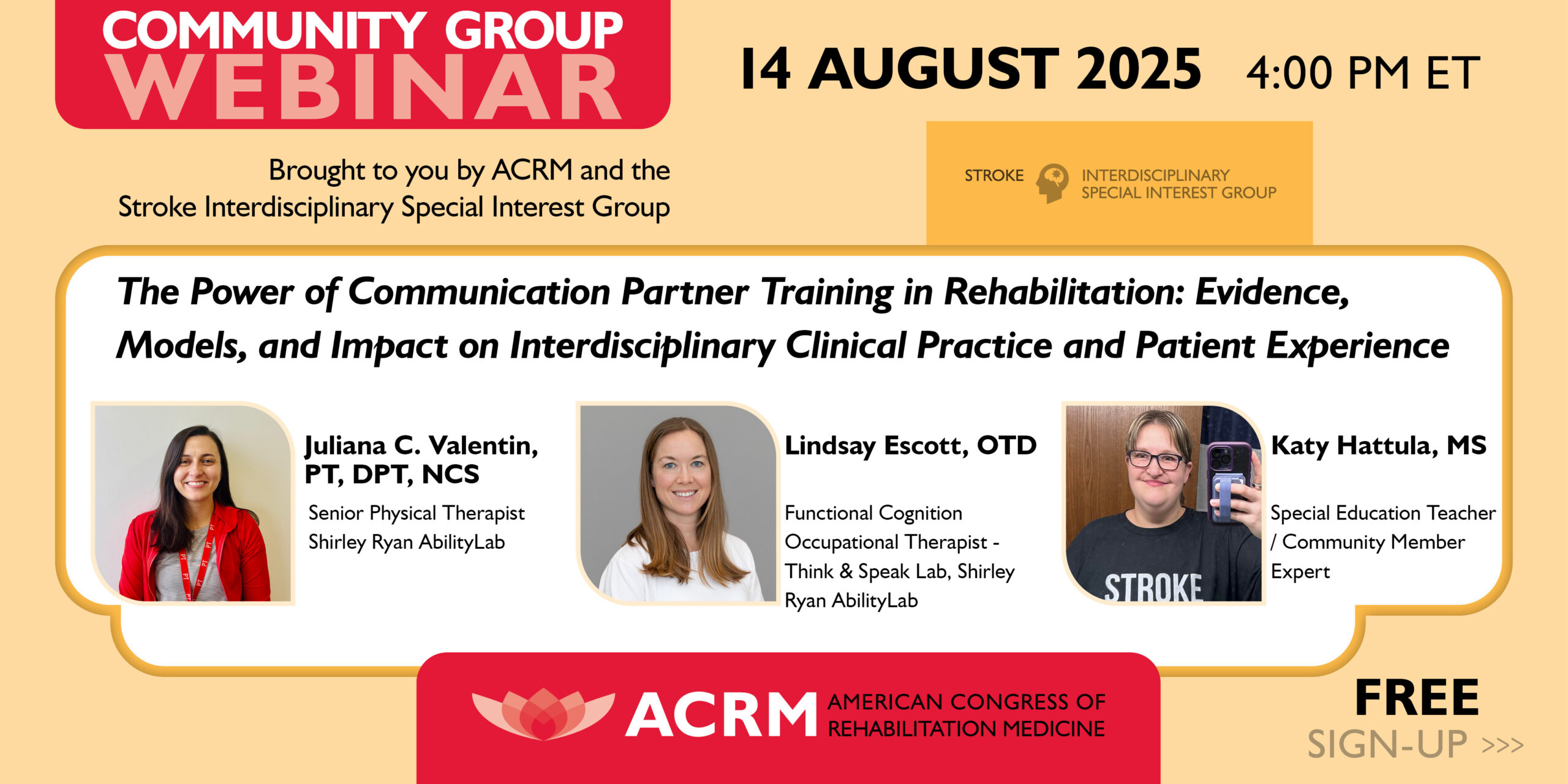
The Power of Communication Partner Training in Rehabilitation: Evidence, Models, and Impact on Interdisciplinary Clinical Practice and Patient Experience
With guest speakers, Juliana C. Valentin, PT, DPT, NCS, Lindsay Escott, OTD, Katy Hattula, MS
Moderated by Elissa Larkin, MS, CCC-SLP, HEC-C
Many patients across rehabilitation settings have diagnoses that affect their speech, language, hearing, cognition, and/or voice, and therefore their ability to understand and be understood by others. Accurate information exchange is critical for optimizing rehabilitation outcomes and ensuring equitable care, and the provision of communication accommodations for patients who need them is included in best practice standards (e.g., The Joint Commission, 2010). Therefore, providers must be empowered with the knowledge and skills to meet their patients’ communication needs. Communication partner training (CPT) is an evidence-based approach to teaching communication accommodation skills and has been shown to be effective for varied interdisciplinary healthcare professional trainees (Cruice et al., 2018).
This panel includes a Speech-Language Pathologist and CPT facilitator, an Occupational Therapist and Physical Therapist CPT trainees, and a community member expert with lived experience of accessing healthcare with a communication disability. The CPT facilitator will describe evidence-based CPT components, training models, and implementation considerations for practicing rehabilitation clinicians. Clinician trainees will share their reflections on how CPT has impacted their clinical practice and patient and family interactions, and a person who is a stroke survivor living with aphasia will compare her experiences with clinicians who did and did not know how to accommodate her communication needs during clinical care. Finally, the panel will invite the audience to engage in collaborative discussion about CPT, and how rehabilitation clinicians and researchers can increase our ability to more effectively accommodate our patients’ communication needs.
LEARNING OBJECTIVES
Upon completion of the webinar, learners will be able to:
- Define Communication Partner Training (CPT) within the context of interdisciplinary clinical education.
- Summarize current best practice evidence related to CPT and implementation considerations in rehabilitation settings.
- Describe examples of CPT impact on interdisciplinary clinical practice and patient experience.
About Juliana C. Valentin
Juliana Valentin is a Senior Physical Therapist at Shirley Ryan AbilityLab in the DayRehab setting. Juliana earned a Doctor of Physical Therapy from Boston University, then later completed advanced training as a Resident at the Northwestern University & Shirley Ryan AbilityLab (SRAlab) Neurologic Physical Therapy Residency. Juliana’s areas of clinical interest are primarily stroke/brain injury recovery, the incorporation of the balance diagnoses framework with emphasis on dual-task training, and the intersection and impact of aphasia on all of the above. Juliana recently completed additional training in strategies to support communication in those with aphasia and other cognitive/communication impairments as a part of the Communication Champions Training Program at SRAlab, and is a resource to her colleagues as a Communication Champion at her site.
About Lindsay Escott, OTD
Lindsay Escott has over 18 years of experience providing care to patients with neurological and medical diagnoses in inpatient rehabilitation settings. Lindsay’s career path has been an international one, and includes clinical experience in Australia, Canada and the United States. Lindsay completed post-professional Masters and Doctorate degrees in Occupational Therapy at Mount Mary University. Through her OTD, she furthered her knowledge of cognitive rehabilitation, functional cognition, adult learning principles and care partner collaboration. Lindsay joined Shirley Ryan AbilityLab in March of 2021 as a functional cognition OT, working in the Think and Speak Lab. She completed the Communication Champions program in 2024 and has since found countless opportunities to integrate supportive communication strategies in her sessions. She is a strong advocate for helping all care partners learn how to support persons with changes to their thinking and movement skills in order to enhance their ability to participate in meaningful occupations.
About Katy Hattula, MS
Katy Hattula earned her Bachelor of Science in Teaching (2015) and Master of Science in Curriculum and Instruction (2018) at Western Illinois University. She started teaching in August of 2015 in Freeport, Illinois. Katy worked for 3 years at an elementary school and then transferred to and continues to teach at Freeport High School. On April 7, 2023, at the age of 31, Katy had a massive stroke. She was airlifted to Mercy Hospital in Rockford, was in the Intensive Care Unit for a week; and then transferred to Shirly Ryan AbilityLab in Chicago for 5 weeks of inpatient rehab. When Katy arrived, she was paralyzed on her right side and could not speak, but she made and continues to make significant progress. Katy went back to work in August, 2023, and continues independent therapy at home.